
The Real Cost of Keys: Rekeying Math for Multi-Site Property Managers
Mechanical keys look free because they don't appear as a line item. But across a multi-site portfolio, key management is a steady drip of locksmith calls, rekeying cascades, lockout visits and staff hours — costs that scale with every tenant turnover. This article puts numbers on the key ledger per 100 doors, then shows what changes when credentials go digital and the lock itself becomes serviceable on site.中文摘要:机械钥匙看起来是免费的,因为它从不出现在预算科目里。但在多网点物业组合中,钥匙管理是持续不断的小额流血:锁匠上门、换锁芯连锁反应、开锁服务与员工工时——每次都随租户换租放大。本文按每 100 樘门算清这笔钥匙账,再说明凭证数字化与锁体可现场维修后会发生什么变化。(正文为英文)
The Key Ledger Nobody Adds Up
A mechanical lock's invoice is honest; its operating costs are not. The real ledger of a master-keyed portfolio includes: key cutting and tagging for every new tenant and staff member; key collection rounds at every move-out (and the keys that don't come back); lockout calls when tenants lose keys at midnight; and the audit gap — a mechanical lock keeps no record of who opened which door when, which matters the day a dispute or an insurance claim arrives. None of these items is large alone. Across a 300-door portfolio with typical annual tenant turnover, they add up to a standing operational tax that repeats every single year.
Rekeying Cascades: How One Lost Key Becomes a Building-Wide Bill
The sharpest cost in mechanical systems is the cascade. A master-keyed building trades convenience for correlated risk: one lost master key can force cylinder changes across every door it opens. What started as a misplaced key becomes dozens of new cylinders, new key cutting, redistribution rounds and updated key charts — with locksmith labour at $50–$150 per visit on top. Even sub-master losses hit a whole floor or wing. Property managers who track these events usually find two to four cascade events per year in a mid-size portfolio, each consuming days of coordination. The cascade is a structural property of mechanical keying: the only way out is to change what a credential is.
What Changes When Credentials Go Digital
On the Trueway RF-2, a credential is data, not metal. Tenant moves out? Their IC card (capacity 50 per door) and fingerprint (semiconductor sensor, identification in about 1.5 seconds, capacity 100) are revoked remotely through built-in Tuya WiFi on 2.4GHz networks — no locksmith, no cylinder, no collection round. New tenant? Issue a card, enroll a fingerprint or send an app-issued password in minutes. Contractors get time-boxed temporary passwords instead of borrowed keys. Unlock records per door close the audit gap that mechanical systems leave open. And the mechanical key stays under management control as the final fallback — doors remain operable without power or network, with a USB-C emergency power port covering depleted batteries. The goal is not to eliminate the key; it is to stop depending on it daily.
Key Management Cost Comparison (Per 100 Doors, Annual)
| Cost Item | Mechanical Master-Key System | Key-Swappable Smart Lock (RF-2) |
|---|---|---|
| Tenant turnover credential change | Locksmith rekey or cylinder swap; $50–$150 per visit + key cutting | Remote revocation via Tuya WiFi 2.4GHz; minutes, no site visit |
| Lost master key event | Cascade: dozens of cylinders, redistribution rounds | No master credential to lose; per-door revocation |
| Lockout response | Locksmith call-out, often after hours | Temporary password issued by app; mechanical key backup on site |
| Audit trail for disputes | None — no record of openings | Per-door unlock records |
| Lock failure repair | Locksmith visit $50–$150, parts wait | $15–$45 spare module swapped on site in under 10 seconds |
The Service Layer: Keeping Digital Locks Cheap to Run
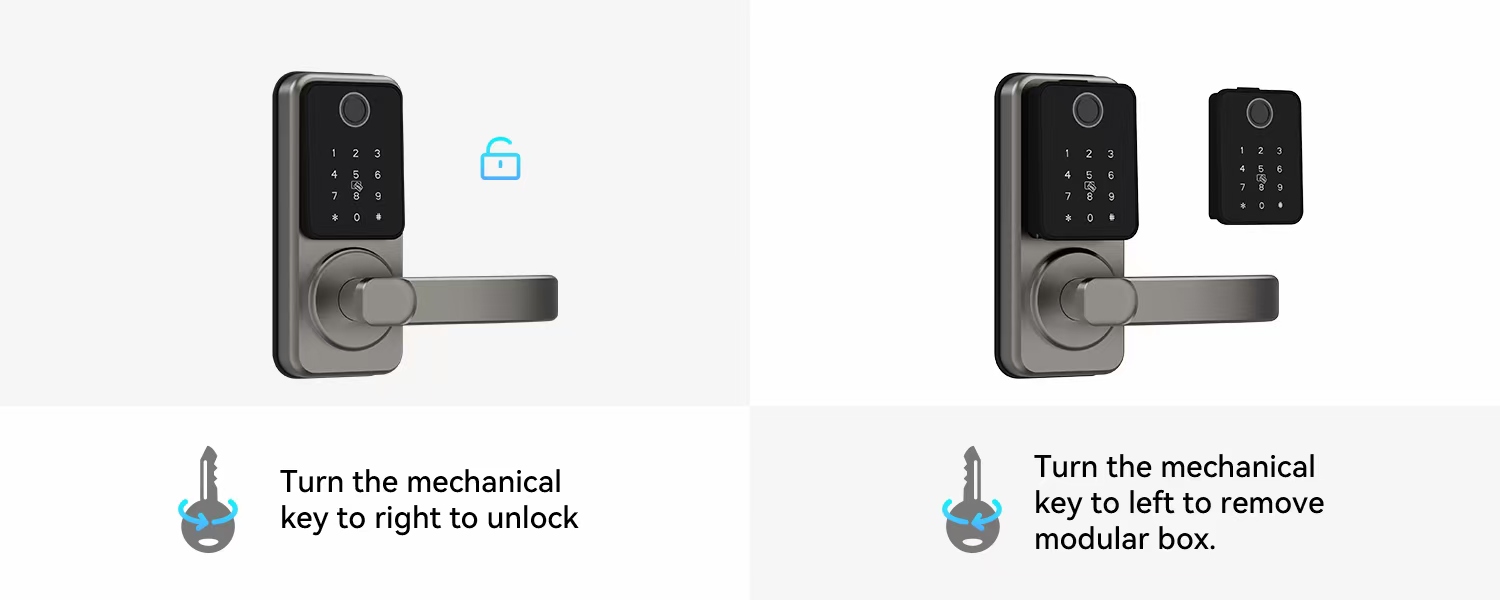
Digital credentials remove the rekeying bill, but a conventional smart lock introduces a new one: every electronic failure is a sealed-unit repair — a technician visit at typically $50–$150, or a full lock return that leaves a tenant's door in limbo. Trueway's patented key-swappable structure (US 12,499,723 B1 · DE202025001780 · CN201610502753, design patents CN202630085403 / CN202630085870, under multi-country patent protection) closes that gap. Turn the mechanical key right to open the door; turn it left 90° and the front-panel module — reader, electronics, firmware — releases. On-site staff click a $15–$45 spare module into place in under 10 seconds, and the door is back in service before a tenant complaint escalates. The platform is designed to cut after-sales service visits by up to 80%. For the distributor or integrator holding the maintenance relationship, Stock Modules, Not Locks turns the service contract from a dispatch burden into a courier-and-shelf model.
Pilot One Building, Then Standardize the Portfolio
The credible path for a property group is a measured pilot: one building or one floor, run through a real turnover cycle, tracking three numbers — rekeying events avoided, lockout calls eliminated, staff hours returned. Trueway supports small trial orders, and a mixed module kit lets the pilot cover different door types on a single lock body. Every unit is assembled at the 2,500㎡ Zhongshan factory with aging, salt-spray and high/low-temperature testing before packaging; the company states plainly that it does not manufacture circuit boards and operates no SMT lines, sourcing electronic modules from qualified suppliers. Scale decisions then rest on measured data: spare-module stocking at the $15–$45 band, written supply terms, and — for groups or distributors building their own label — OEM / ODM customization at volume.
FAQ
What does a rekeying cascade actually cost?
One lost master key can force cylinder changes across every door it opens — in a master-keyed building that can mean dozens of cylinders, new key cutting and redistribution rounds. Each event carries locksmith labour at $50–$150 per visit plus staff time. Digital credentials replace the cascade with a remote revocation that takes minutes.
How do digital credentials handle tenant turnover?
On the RF-2, outgoing tenants' cards and fingerprints are revoked remotely through built-in Tuya WiFi (2.4GHz) — no locksmith, no cylinder change, no key collection. New tenants receive an IC card (capacity 50 per door), a fingerprint enrollment (capacity 100) or an app-issued password, and unlock records per door support dispute resolution.
What happens when a smart lock fails on a tenant's door?
On a conventional smart lock, failure means a technician visit at typically $50–$150 plus waiting time with an unhappy tenant. On Trueway's key-swappable platform, on-site staff turn the mechanical key 90° left, release the front-panel module and click a $15–$45 spare into place in under 10 seconds. The platform is designed to cut after-sales service visits by up to 80%.
Does going keyless mean losing the mechanical fallback?
No. Trueway locks keep a mechanical key override under management control, so doors stay operable without power or network. A USB-C emergency power port covers depleted batteries. The goal is not to eliminate the key but to stop depending on it — keys become the backup, not the daily workload.
How should a property manager pilot smart locks across a portfolio?
Pilot one building or one floor through a real tenant-turnover cycle: track rekeying events avoided, lockout calls and staff hours. Trueway supports small trial orders, and the mixed module kit covers different door types on one lock body. Scale with a spare-module stocking plan at the $15–$45 band and written supply terms.
Related reading: Smart Lock vs. Traditional Lock: The 5-Year TCO Math for Property Portfolios · Smart Locks for Rental Apartments and Airbnb: A Procurement Guide.
Learn more: RF-2 product page · production & QC · patents & certifications · B2B FAQ.
Managing keys across multiple sites? Ask for a per-door cost worksheet and a pilot-building quotation.正在管理多网点的钥匙?欢迎索取单门成本测算表与试点楼栋报价。