
Smart Lock vs. Traditional Lock: The 5-Year TCO Math for Property Portfolios
A mechanical lock is cheaper on the invoice — that much everyone sees. What the invoice hides is five years of rekeying, lockouts, locksmith scheduling and out-of-service rooms. This article prices the full ownership picture per 100 doors across three options: mechanical locks, conventional smart locks, and key-swappable smart locks — so distributors and property buyers can run the same math with their own numbers.中文摘要:机械锁在发票上更便宜——这一点人人都看得见。发票看不见的是五年的换锁芯、锁门外求助、 开锁匠调度和停用房间。本文按每 100 樘门为三种方案算清五年总持有成本:机械锁、传统智能锁、钥匙换模块智能锁,方便经销商与物业买家套用自己的数字。(正文为英文)
Why the Purchase Price Is the Wrong Comparison
Every portfolio buyer has had this conversation: the mechanical lock costs a fraction of the smart lock, end of discussion. But door hardware is not a one-time purchase — it is a five-year operating commitment. Tenant turnovers trigger rekeying. Lost keys trigger locksmith calls. Master-key systems need administration. And when anything fails, someone has to drive to the door. Priced honestly, the question is not "what does the lock cost" but "what does five years of this door cost." For distributors, the same framing wins deals: you are not selling a more expensive lock, you are selling a cheaper decade.
The Cost Lines That Decide the Comparison
Four recurring cost lines dominate the five-year picture. Turnover rekeying: on a mechanical lock, every tenant change means a locksmith or a cylinder swap; on the RF-2, credentials are deleted and reissued remotely through built-in Tuya WiFi (2.4GHz) in minutes — fingerprint (capacity 100), IC card (capacity 50), password, app and key cover every user type. Lockouts: a forgotten or lost key on a mechanical lock is a locksmith visit; on a smart lock it is a temporary password sent from a phone, with USB-C emergency power covering a flat battery. Failure service: the $50–$150 technician visit is the industry norm when a conventional smart lock fails, because the sealed unit has to come off the door. Downtime: a room that cannot be rented or a unit that cannot be shown is lost revenue priced per day — the repair path's speed matters more than its invoice.
Five-Year Cost Comparison per 100 Doors
The structure below is the comparison framework; plug in your local labor rates and turnover frequency to get your own numbers.
| Cost Line (5 years, per 100 doors) | Mechanical Lock | Conventional Smart Lock | Key-Swappable Smart Lock (Trueway) |
|---|---|---|---|
| Hardware | Lowest upfront | Mid | Mid |
| Turnover rekeying | Locksmith or cylinder swap every turnover | Remote credential change, minutes | Remote credential change, minutes |
| Lockout events | Locksmith visit per event | Temporary password from the app | Temporary password + USB-C emergency power |
| Failure service | Locksmith visit | Technician visit at $50–$150; lock off the door | $15–$45 module, swapped with a key in under 10 seconds |
| Downtime per failure | Hours to days | Days (scheduling + parts) | Minutes — room back in service on the spot |
| Spare inventory | Cylinders and keys | Model-specific spare locks | Stock Modules, Not Locks — a drawer of $15–$45 modules |
Where the Key-Swappable Design Changes the Math
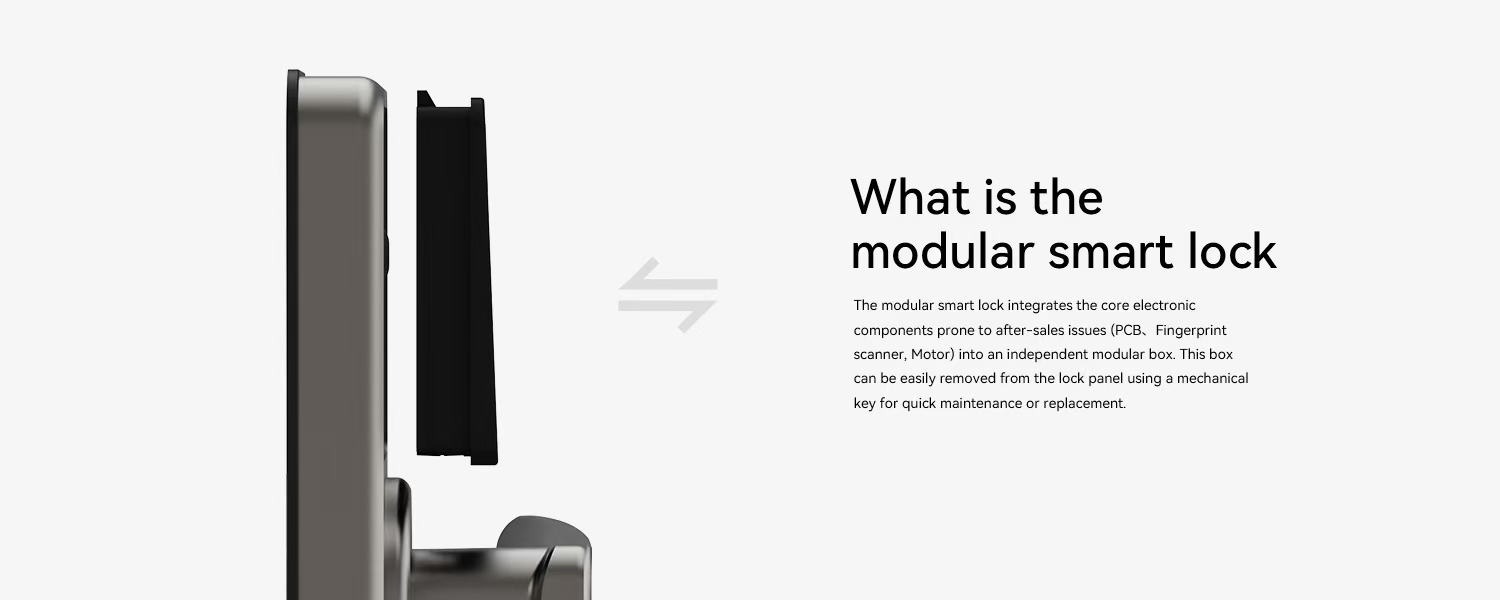
Against mechanical locks, the smart lock's case rests on eliminating rekeying and lockout labor — real, but shared by every smart lock on the market. The sharper comparison is between smart lock architectures. A conventional smart lock keeps one foot in the mechanical world: every electronic failure still means a technician, a scheduling delay and a lock off the door. Trueway's patented key-swappable structure (US 12,499,723 B1 · DE202025001780 · CN201610502753, design patents CN202630085403 / CN202630085870) removes that residue: turn the mechanical key right to open the door, turn it left 90° and the front-panel module — reader, electronics, firmware — releases. A $15–$45 spare module clicks in within under 10 seconds, installed by facility staff with no tools. The platform is designed to cut after-sales service visits by up to 80%, which is precisely the cost line where conventional smart locks lose their advantage over mechanical ones.
Modeling Downtime Honestly
Downtime is the line most spreadsheets skip, because it prices the room rather than the lock. A serviced-apartment unit with a failed lock cannot be sold tonight; a hotel room waiting on a technician is out of order inventory. Multiply your daily unit revenue by realistic repair lead times — days for a dispatched technician with parts, minutes for a module swap from the maintenance drawer — and the five-year delta often exceeds the entire hardware budget. This is also the argument that lands with asset owners and property managers in a tender: uptime is a revenue metric, not a maintenance metric.
Run Your Own Numbers Before You Commit
The honest way to settle the comparison in your market is a pilot. Trueway supports small trial orders: equip one building, run it through a full turnover cycle, and track rekeying-equivalent events, battery intervals, failure response times and support tickets. Extrapolate per 100 doors with your own labor rates and room revenue. Every unit ships from Trueway's 2,500㎡ Zhongshan factory after aging, salt-spray and high/low-temperature testing, with FCC-ID and CE-RED certifications for the US and EU; the company assembles locks and modules but transparently operates no SMT lines, sourcing electronic modules from qualified suppliers. For OEM and ODM partners, the same TCO model works under your own brand — the module economics are the differentiator your customers will calculate for themselves.
FAQ
Is a smart lock worth the higher purchase price for rental portfolios?
In portfolios with regular tenant turnover, usually yes: every turnover on a mechanical lock means rekeying labor and locksmith scheduling, while on a WiFi-connected smart lock it means deleting and issuing credentials remotely in minutes. Add lockout calls and master-key administration, and the operating savings typically outweigh the hardware premium within the first turnover cycles — run the math per 100 doors with your own labor rates.
What is the biggest hidden cost of conventional smart locks?
The service visit. When a sealed smart lock fails, a technician has to come to the door — typically $50–$150 per visit — and the lock often has to come off the door entirely. On a key-swappable platform, the same failure is a $15–$45 replacement module installed with the mechanical key in under 10 seconds. The platform is designed to cut after-sales service visits by up to 80%.
How should I model downtime cost?
Price the room, not the lock: a hotel room or rental unit with a failed lock cannot be sold. Multiply your daily unit revenue by the days a repair takes — a technician dispatch measured in days versus a module swap measured in minutes is where key-swappable designs change the five-year picture most.
Do smart locks create new costs that mechanical locks don't have?
Two: batteries and connectivity. Batteries are manageable with a scheduled replacement cycle per building, and the RF-2's USB-C emergency power port covers the exceptions. Connectivity costs nothing extra on the RF-2 — built-in Tuya WiFi on 2.4GHz networks is standard, with no gateway hardware to buy or maintain.
Can I validate the TCO case before converting a whole portfolio?
Yes. Trueway supports small trial orders: equip one building, track rekeying-equivalent events, battery intervals, failure response time and support tickets for a full turnover cycle, then extrapolate per 100 doors with your own labor and room-revenue rates. The pilot numbers make the business case for you.
Learn more: after-sales ROI calculator · RF-2 product page · patents & certifications · B2B FAQ.
Want a TCO worksheet for your portfolio — with module pricing and pilot terms for your market?想要一份适合你物业组合的 TCO 测算表(含模块价格与试点条款)?