
Key-Swappable vs. Conventional Smart Locks: A Total-Cost Comparison for Distributors and Project Buyers
Two smart locks can look identical on a spec sheet and produce completely different P&Ls over five years. The difference is architecture: whether the electronics, motor and battery system are sealed into the lock, or built as independent modules that release with a 90° turn of the mechanical key. This comparison puts the two structures side by side on the numbers B2B buyers actually budget — cost per failure, downtime, spare inventory, upgrade path and specification risk.中文摘要:两把参数表上看起来一样的智能锁,五年下来会走出完全不同的成本曲线。差别在架构:电子、电机、电池是封死在锁体里,还是做成用机械钥匙旋转 90° 即可取下的独立模块。本对比围绕 B 端采购真正要算账的几行展开——单次故障成本、停机时间、备件库存、升级路径与规格风险。(正文为英文)
Quick answer: which architecture fits your cost model?
For distributors, contractors and white-label partners that pay for service visits and downtime, a key-swappable architecture is a strong candidate when module-level repair and shared spares matter. Conventional locks can remain rational where initial unit price is the priority, technician labor is inexpensive and the installed base is small. Compare your own failure rate, labor and courier costs rather than treating either architecture as the default for every project.
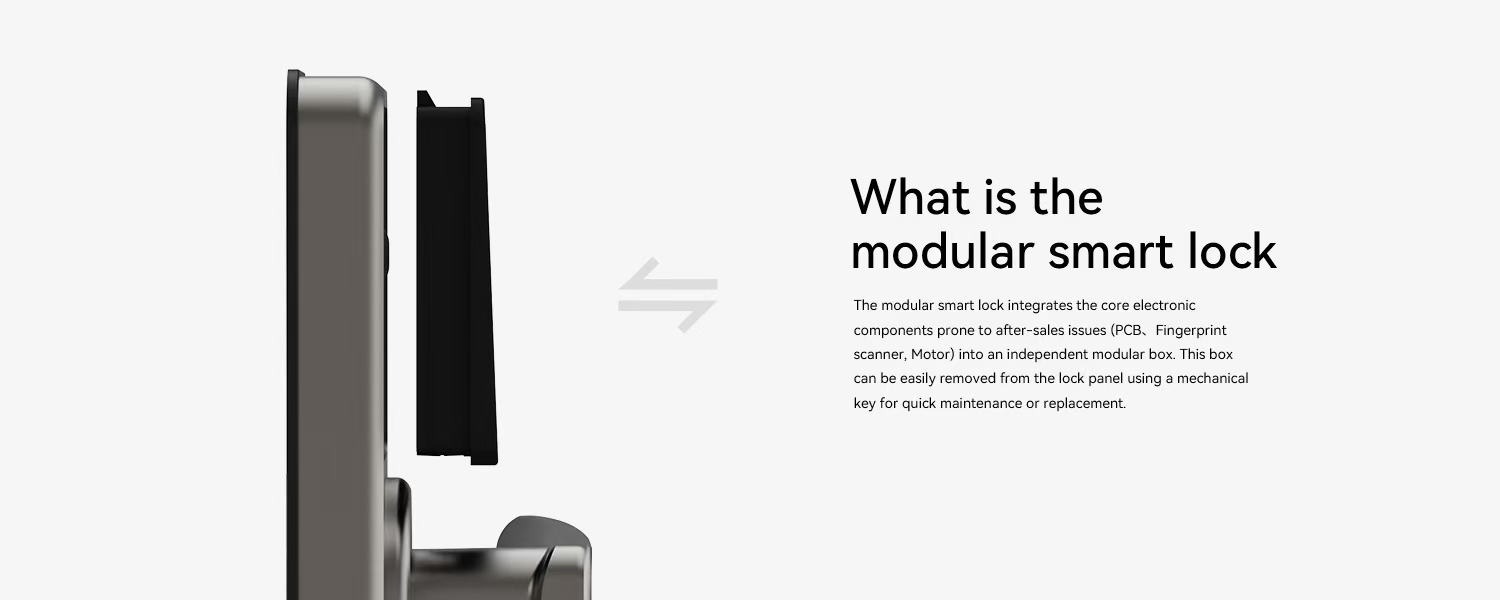
What "Key-Swappable" Means in Practice
In a conventional smart lock, the reader, control electronics and motor drive are sealed into the lock body. When any of them fails, the whole lock comes off the door and a technician visit follows — in most export markets a $50–$150 event once labor, travel and scheduling are counted, with the door down for hours or days. Trueway's patented key-swappable structure (US 12,499,723 B1 · DE202025001780 · CN201610502753, with design patents CN202630085403 / CN202630085870 on the RF-2 and RF-3) takes a different approach: the electronic, motor and battery modules are independent units inside the lock body. Turn the mechanical key right and the door opens; turn it left 90° and the module releases. A replacement module at $15–$45 clicks into place in under 10 seconds, installed by a distributor's own staff or trained facility personnel — no technician dispatch, no lock body removal, no door out of service.
The Comparison, Line by Line
| Procurement Factor | Conventional Smart Lock | Trueway Key-Swappable |
|---|---|---|
| Typical repair event | Whole lock off the door; technician visit scheduled | Module swap with the mechanical key, in under 10 seconds |
| Cost per failure | $50–$150 service call, plus scheduling overhead | $15–$45 replacement module, shipped by parcel |
| Door downtime | Hours to days; a hotel room or rental unit out of order | Seconds; the door stays in service |
| Spare inventory | Whole locks or model-specific boards; capital tied up per SKU | Modules only — stock modules, not locks; padded-envelope logistics |
| Feature upgrades | Replace installed locks to move to a newer feature set | Swap the module on the same lock body; upgrades become repeat revenue |
| Mid-project spec changes | Reorder different lock models; lead time resets | One lock body, different modules — hotel, apartment, office or residential config |
| Technician dependence | Trained technician required on-site for most failures | Distributor staff or trained facility personnel handle swaps |
| Design protection | Commodity structures, freely copied; price-war exposure | Invention and design patents across US, Germany and China support differentiation |
Where Conventional Locks Can Still Be the Rational Choice
An honest comparison has to name the cases where the conventional structure is defensible. Basic conventional models can carry a modestly lower unit price, and for a single-site project in a market where technician labor is abundant and cheap, the service-call curve stays manageable. If you are an end user fitting one door — rather than a distributor, contractor or white-label partner carrying a portfolio — the after-sales math is someone else's problem. The calculation shifts as soon as you own the failure events: the moment your company pays for the visits, the unit price stops being the number that matters.
Reading the Table as a P&L
Take a 500-lock portfolio at a 5% annual failure rate: 125 failure events over five years. On conventional hardware, that is 125 service calls at $50–$150 each — $6,250 to $18,750 in after-sales cost, before counting downtime, tenant complaints or hotel rooms out of order. On the key-swappable platform, the same 125 events are module swaps at $15–$45 — $1,875 to $5,625, handled by your own staff the day the parcel arrives. The platform is designed to cut after-sales service visits by up to 80%, and the gap widens in markets where technicians are scarce or travel is expensive. Run your own portfolio numbers on the after-sales ROI calculator before your next supplier negotiation.
Specification Risk: The Row Buyers Underweight
The least-priced row on the table is the one that hurts most when it goes wrong: specification change. Projects evolve mid-stream — a hotel adds card-plus-mobile access, a landlord standardizes on app-managed WiFi locks after phase one. With conventional locks, a spec change means a different model, a new lead time and sometimes a new supplier. With a key-swappable platform, the lock body stays on the door and the module defines the feature set: the RF-2 alone covers semiconductor fingerprint (identification in about 1.5 seconds, capacity 100), IC card (capacity 50), anti-peep password, built-in Tuya WiFi on 2.4GHz networks and the mechanical key, with a USB-C emergency power port for flat-battery events. For OEM/ODM and white-label partners, the same architecture means one certified body with custom modules, branding and firmware — and patent protection that commodity suppliers cannot offer your brand.
Sources & planning assumptions
Verify product claims on the RF-2 page and protection records on the patents page. The 500-lock portfolio and 5% annual failure rate above are a calculation scenario, not customer results. The $15–$45 module and $50–$150 service-call figures are planning bands; actual pricing, labor, duties, courier costs and downtime vary by market and contract. Replace the assumptions with your own inputs in the ROI calculator.
FAQ
Is the key-swap mechanism a security risk?
The module release is driven by the same mechanical key cylinder that opens the door — a holder of the mechanical key already has physical access by definition. There is no external release on the module bay, and electronic credentials (fingerprint, card, password, app) cannot release the module. For project deployments, key control policies apply to the module swap exactly as they do to the mechanical override.
Can modules be retrofitted into locks already installed from other brands?
No — the swappable structure is built into the lock body itself, so the switch happens at the point of purchase. For mixed estates, the practical path is to standardize new procurement and failure replacements on the key-swappable body; Trueway supports small trial orders so you can validate the structure on representative doors before a volume commitment.
Do conventional smart locks cost less to buy?
Basic conventional models can carry a modestly lower unit price. But the purchase price is a small share of five-year ownership cost once failures at $50–$150 per service call are counted against $15–$45 module swaps — the platform is designed to cut after-sales service visits by up to 80%. Run both curves with your own failure rate and labor costs on the ROI calculator.
Learn more: RF-2 product page · patents & certifications · after-sales ROI calculator · B2B FAQ.
Related reading: How Key-Swappable Modular Design Cuts After-Sales Costs by up to 80% · The Hidden After-Sales Bill: What a Failed Smart Lock Really Costs a Distributor.
Comparing suppliers for a project or distribution program? Ask for a side-by-side quotation with module pricing and a trial order.正在为项目或经销计划对比供应商?欢迎索取含模块价格的对比报价与试单方案。