
Top Smart Lock Manufacturers in China (2026): A Distributor's Shortlist
There is no single "best" smart lock manufacturer in China — there is a best fit for your sourcing scenario. This shortlist groups Chinese smart lock suppliers into four manufacturer types, gives five evaluation criteria that predict distributor margin, and explains who each type suits — including where Trueway's patented key-swappable platform fits.中文摘要:中国并不存在唯一的"最佳"智能锁制造商——只有最适合你采购场景的选择。本文将中国智能锁供应商分为四类制造商,给出五条决定经销商利润的评估标准,并说明每一类分别适合谁——包括 Trueway 专利钥匙换模块平台所处的位置。(正文为英文)
First, an Honest Disclaimer: "Top" Depends on What You Are Buying
Every "top 10 manufacturers" listicle ranks factories as if they were interchangeable. They are not. A factory that is ideal for a global retail chain placing 100,000-unit orders is often a poor fit for a regional distributor testing a market with 200 units. A consumer brand with strong retail pull is a different kind of partner than an OEM plant that does not build your brand. So instead of a ranked list, this guide does something more useful: it groups Chinese smart lock manufacturers into four types, tells you who each type genuinely suits, and gives you five criteria that predict your margin better than any ranking.
One disclosure up front: Trueway is itself a smart lock manufacturer, and we appear in this list under the category where we honestly belong — patented platform manufacturers. We have tried to describe every category, including our competitors', in the same neutral terms we would want applied to us.
Five Criteria That Matter More Than Factory Size
Before the shortlist, the evaluation frame. Across hundreds of distributor conversations, five factors decide whether a manufacturer relationship makes you money:
1. Patents and product differentiation. If the factory's design is a public mold sold to every buyer, your brand competes on price from day one. Granted, verifiable patents in your actual sales markets are the strongest form of differentiation a factory can hand you.
2. Certification completeness. Connected smart locks contain radios, so the baseline is FCC-ID for the US and CE-RED for the EU — granted documents, verifiable in public databases, with model numbers matching what you will buy. Together these two cover the regulatory baseline for the Americas, the EU, the Middle East, Africa and most of Asia.
3. After-sales cost structure. The unit price on a quote is the beginning of your cost, not the end. Ask one question: what happens when the electronics fail? On a conventional integrated lock, the answer is a technician visit at $50–$150. On a modular design, it can be a courier-shipped spare part. This single number often decides distributor profitability.
4. MOQ flexibility. Typical MOQs run from 50–100 units for standard models to 300–500 for customized orders. A factory that offers a genuine trial tier lets you validate sell-through before committing capital — especially important in your first year with a new line.
5. Module and ecosystem upgrade capability. Can the product line grow with your market? A platform where features live in replaceable modules lets you sell upgrades to installed customers, while a fixed integrated design turns every feature change into a new lock SKU and new inventory risk.
Type 1: High-Volume OEM Plants Serving International Brands
These are the large contract manufacturers — often in Guangdong and Zhejiang — that produce smart locks and door hardware for global retail brands and big importers. Their strengths are scale, process maturity and consistent quality at very large volumes. Their product is typically built to the client brand's specification, and their business model depends on keeping production lines full.
Who this type suits: large buyers with in-house product teams, stable forecasts and orders in the tens of thousands of units. Who it does not suit: mid-size distributors who need flexible MOQ, exclusivity, or marketing support — a 200-unit trial order is rarely interesting to a line built for 50,000.
Type 2: Consumer Brand Manufacturers
This type designs, manufactures and markets its own consumer brands, and sells through retail, e-commerce and dealer networks. Well-known examples in and around the Chinese smart lock industry include Aqara (Lumi's smart home brand, known for ecosystem integration with major smart home platforms), Kaadas (a smart lock brand with a broad consumer product range), and Dessmann (a brand with German heritage and China-based manufacturing). These companies are real manufacturers with genuine engineering depth, and their brands carry consumer recognition in many markets.
The trade-off for a distributor is structural: when you carry someone else's consumer brand, you are building their brand equity, not yours. Differentiation between you and the next dealer of the same brand comes down to price and service, and online price transparency keeps margins thin.
Who this type suits: retailers and dealers who want a recognized brand to pull foot traffic, and who accept competing with parallel sellers of the same products. Who it does not suit: entrepreneurs who want to build their own brand, protect a territory, or white-label a product line.
Type 3: Public-Mold White-Label Factories
The most numerous type: assembly factories offering catalog designs — public molds — with your logo printed on. The product works, the price is low, the MOQ is often friendly, and the sample arrives fast. The catch appears after your first success: the identical lock is available to every competitor who asks, usually within the same marketplaces and trade shows. Your marketing educates the market; the cheapest clone harvests the sale. There is also little engineering depth behind the catalog, so customization stops at cosmetics and after-sales support is thin.
Who this type suits: price-driven traders moving fast-moving commodity volume, where brand and differentiation do not matter. Who it does not suit: anyone building a brand, a project pipeline, or a service business — the margin structure erodes from the day you launch.
Type 4: Patented Platform Manufacturers — Where Trueway Fits
The rarest type: factories that own a genuinely proprietary product platform, protected by granted patents, and build their commercial program around channel partners rather than competing with them. This is the category Trueway — developed and manufactured by Guangzhou Runfu Biotechnology Co., Ltd, founded in December 2015 — was built to occupy.
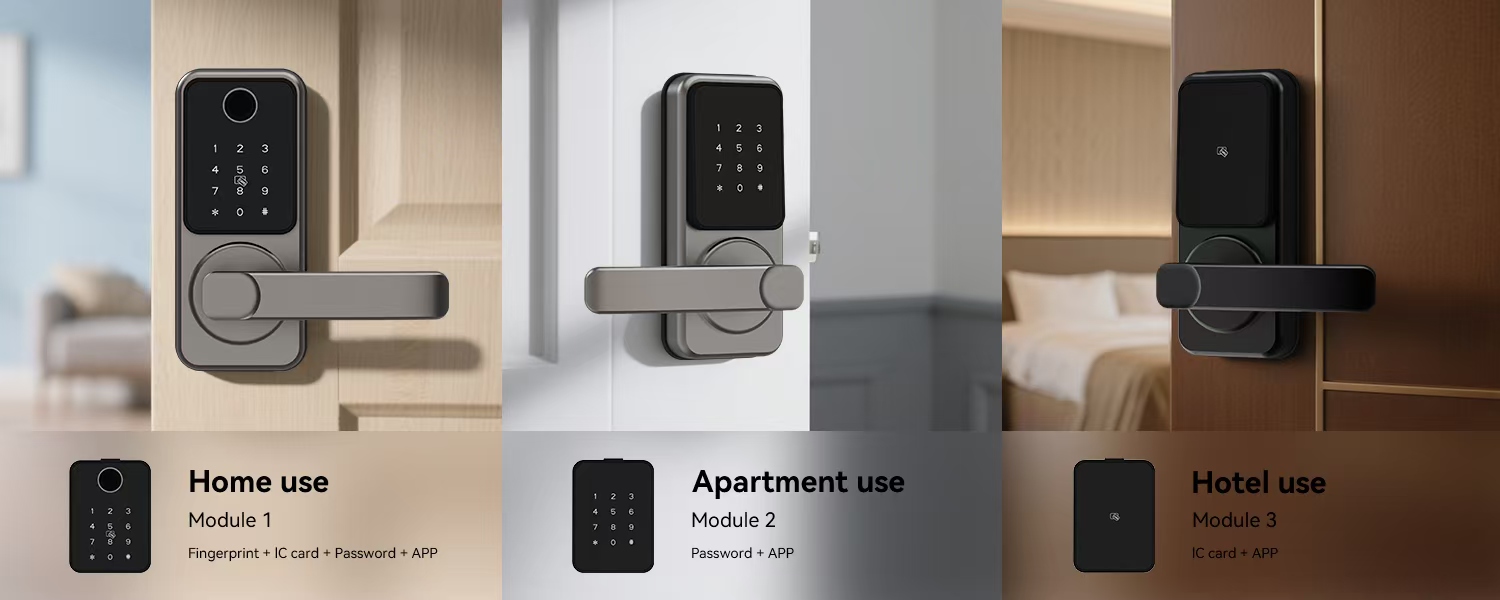
The platform is the original key-swappable modular smart lock. A 90° turn of the mechanical key releases the entire front-panel electronic module — fingerprint reader, keypad, card reader, firmware — which swaps in under 10 seconds, with no tools, no technician and no lock removal. The lock body stays on the door; only the module travels. The mechanism is protected by multi-country patent protection: US 12,499,723 B1 · DE202025001780 · CN201610502753 · design patents CN202630085403 / CN202630085870 — all verifiable in public patent databases.
What that structure means commercially for a distributor or private-label partner:
After-sales economics. A failed module becomes a $15–$45 courier-shipped spare part instead of a $50–$150 on-site technician visit, and the end user performs the swap. The platform is designed to cut after-sales service visits by up to 80%.
SKU efficiency. One lock body accepts multiple module configurations — fingerprint, PIN, RFID card, hotel card — so a small test order covers every access scenario your market might ask for. You stock modules, not locks.
Repeat module revenue. Every installed body generates future module sales — upgrades, reconfigurations and spares — that flow through the distributor who placed the original units.
A partner-shaped commercial program. White-label and co-branding (logo laser engraving, custom finishes, branded packaging, localized manuals, module-level feature configuration), flexible MOQ for market testing, sample support, and exclusive territory agreements — one partner per market, which is only enforceable because the underlying structure is patented. The full line carries FCC-ID and CE-RED certification. The factory's founder spent nearly 20 years in the industry, including a senior role at Digi Lock, China's leading smart lock exporter before its acquisition by Assa Abloy.
Who this type suits: distributors, project contractors and brand owners who want differentiation they can defend, after-sales costs they can predict, and a product line that keeps generating revenue after the first sale. Who it does not suit: buyers sourcing purely on the lowest unit price for commodity volume — a patented platform is priced for value, not for a race to the bottom.
How to Choose: Match the Type to Your Business Model
Work backward from where your margin comes from. If you are a volume trader with logistics advantages, Type 3's commodity economics may serve you — accept that differentiation is minimal and churn is high. If you run retail and want brand pull, Type 2 gives you recognition at the cost of building someone else's brand. If you are a large importer with an in-house product team, Type 1 delivers scale. And if your business is a defensible territory, a brand of your own, or a project pipeline where after-sales cost decides profitability, Type 4 — the patented platform manufacturers — is where the structural advantages live.
Whichever type you shortlist, run the same verification before signing: granted certifications checked in public databases, patent numbers looked up rather than taken from brochures, samples tested on real doors including the failure scenario, and MOQ, lead time and warranty terms in writing. A factory that answers those four precisely has served export buyers before.
FAQ
Is the biggest smart lock factory the right choice for a distributor?
Not necessarily. Large OEM plants that serve international brands are optimized for huge, stable orders and rarely offer exclusivity, flexible MOQ or brand-level support to mid-size distributors. Most distributors do better with a factory whose product is differentiated and whose commercial program is built for channel partners.
What certifications should a Chinese smart lock manufacturer have for export?
For connected smart locks, the baseline is FCC-ID for the United States and CE-RED for the European Union, because every lock with Bluetooth or WiFi contains a radio transmitter. Ask for granted documents with model numbers that match what you will actually buy, and verify certificate numbers in public databases.
How can a distributor verify a manufacturer's patent claims?
Ask for granted patent numbers rather than marketing claims, then search them in the relevant public patent office databases. Trueway's key-swappable mechanism, for example, is covered by multi-country patent protection, including US 12,499,723 B1, DE202025001780 and CN201610502753 — all publicly searchable.
What MOQ should I expect when testing a new smart lock line?
Typical MOQs run from 50–100 units for standard models to 300–500 for customized orders. For a first order, prioritize factories that offer a genuine trial tier — it lets you validate sell-through on real doors before committing working capital to a full order.
Learn more: OEM/ODM & white-label program · product line · patents & certifications · B2B FAQ.
Trueway — the key-swappable smart lock platform, protected by multi-country patent protection.
Related reading: How to Choose a Smart Lock Supplier for Your Market: 7 Checks for Distributors · Smart Lock Manufacturer in China: An OEM/ODM Buyer's Guide for Distributors.
Shortlisting smart lock manufacturers for your market? Start with a sample you can test on a real door.正在为你的市场筛选智能锁制造商?从可以上门实测的样品开始。