
Stock Modules, Not Locks: A Multi-Site Spare-Module and SLA Playbook
Selling locks is a project; servicing them is a business. Distributors and integrators who run multi-site accounts know that the service level agreement is where margin is made or lost. This playbook turns the key-swappable module model into concrete operating numbers: how many spare modules to stock per 100 doors, where to put them, when to reorder, and which SLA response targets you can sign without over-promising.中文摘要:卖锁是项目,养锁才是生意。做多网点客户的经销商和工程商都清楚:SLA 服务时效条款才是毛利的胜负手。本文把钥匙换模块模式落成具体运营数字:每 100 樘门备多少模块、放在哪里、何时补货,以及哪些 SLA 响应指标可以放心签进合同。(正文为英文)
Quick answer: how should you set the first spare pool and SLA?
Start with 3–5 spare modules per 100 doors as an initial planning assumption—not a measured failure rate—and replace it with observed swaps after two quarters. Same-day restoration is realistic only when the correct module is stocked on site and trained staff are available; remote-site targets depend on the courier lane. Put module mix, replenishment lead time, warranty returns and escalation responsibility in the SLA.
Why the SLA, Not the Lock Price, Decides Your Margin
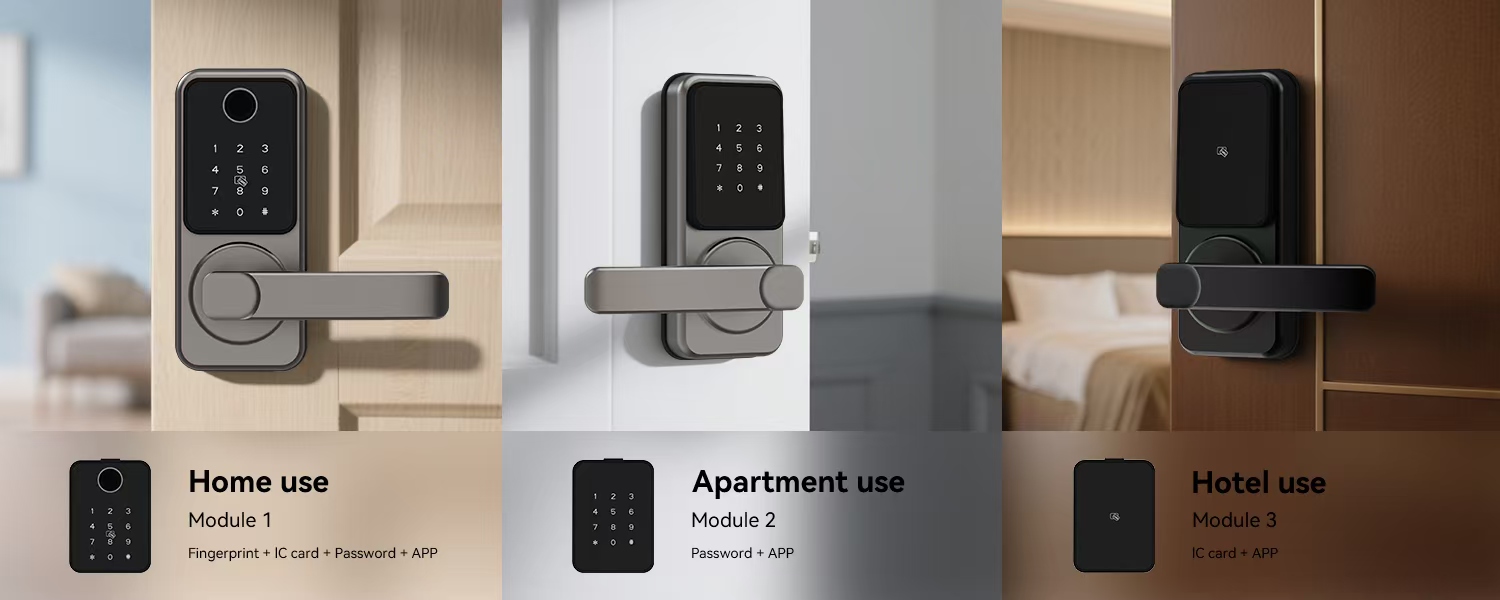
On a conventional smart lock account, every failure is a dispatch: a technician drives out, typically at $50–$150 per visit, diagnoses, and often returns with parts. The SLA you signed last year becomes this year's margin leak. On Trueway's key-swappable platform, the same failure is a logistics event instead: a $15–$45 spare module from the shelf, swapped on site in under 10 seconds. The platform is designed to cut after-sales service visits by up to 80%. The practical consequence for a distributor is that an SLA stops being a risk you price defensively and becomes a product you can sell — faster restoration than competitors, at a cost structure they cannot match with sealed locks.
Stocking Levels: A Working Formula per 100 Doors
Start simple and let measured data refine it. A sensible opening position is 3–5 spare modules per 100 doors at the customer's central site, held against the observed failure pattern of your installed base. At $15–$45 per module, that starter pool for 100 doors costs roughly $45–$225 — less than one conventional technician visit once you count the downtime. After two quarters, replace the estimate with your own number: track swaps per 100 doors per month, then hold one month of demand plus a small safety buffer. Multi-site accounts add one refinement: put a one-or-two-module mini-pool at each satellite site so even the furthest door doesn't wait on the central warehouse.
Where the Pool Sits Determines What You Can Promise
The stocking map is the SLA map. On-site pools support same-day restoration because the repair is a staff task: turn the mechanical key right to open the door, turn it left 90° and the front-panel module — reader, electronics, firmware — releases; click the spare in and the door is back in service. For remote sites, the module travels by courier in a padded parcel instead of a technician in a van, so your response target follows the courier lane, not the technician's calendar. This is also why the swap needs no specialist certification: the mechanical key is the entire toolkit, and facility staff or reseller counter staff can perform it after a short drill. Your labor pool expands from scarce lock technicians to whoever is already there.
Reorder Points and Replenishment Rhythm
Run the pool on a min-max rule. Reorder when stock drops below one month of observed swaps plus the safety buffer; review the buffer quarterly against the failure trend. Because modules are small and light, replenishment moves by parcel rather than pallet, so reorder cycles stay short and emergency air freight is affordable when needed. One operational habit pays for itself: log every swap with door ID, module type and fault description. That log turns into your failure-rate curve, your next quotation's stocking annex, and your evidence in warranty conversations with the factory.
Stocking & SLA Tiers by Account Size
| Account Profile | Starter Pool | Service Model | Realistic SLA Target |
|---|---|---|---|
| Single building, up to 100 doors | 3–5 modules on site ($45–$225) | Facility staff swap in under 10 seconds | Same-day restoration |
| Multi-site, same city | Central pool + 1–2 modules per satellite | On-site swap; central replenishment rounds | Same-day / next-morning |
| Regional, mixed urban & remote | Hub pool + satellite mini-pools | Module by courier; faulty module returns by post | Follows courier lane, not technician availability |
| Distributor channel stock | Scaled to installed base, $15–$45 band | Reseller counter staff trained on the swap | Counter-level immediate service |
Put the Module Agreement in Writing
A stocking plan is only as strong as its supply terms. Four items belong in the agreement with your factory: module pricing held in the $15–$45 band, replenishment lead times, a per-quarter stocking commitment tied to your installed base, and warranty handling for returned modules. Trueway's patented key-swappable structure (US 12,499,723 B1 · DE202025001780 · CN201610502753, design patents CN202630085403 / CN202630085870, under multi-country patent protection) is backed by assembly and QC at the 2,500㎡ Zhongshan factory — aging, salt-spray and high/low-temperature testing on every unit — and the company states plainly that it does not manufacture circuit boards and operates no SMT lines, sourcing electronic modules from qualified suppliers. Start with a small trial order and a pilot pool, scale on measured swap data, and OEM / ODM partners can run the identical structure under their own brand.
Evidence & planning assumptions
The RF-2 page documents product specifications; patent records and assembly and QC support the platform claims. The 3–5 modules per 100 doors, $45–$225 starter pool and SLA tiers are planning assumptions, not field performance data. The $15–$45 module and $50–$150 service-call bands are procurement inputs, not a quotation or universal market averages. Recalculate with your installed base, local labor and courier commitments.
FAQ
How many spare modules should we stock per 100 doors?
A practical starting band is 3–5 modules per 100 doors at a central site, scaled by observed failure rates after the first two quarters. At $15–$45 per module, a starter pool for 100 doors costs roughly $45–$225 — less than a single conventional technician visit at $50–$150 plus the lock downtime it involves.
What SLA response times can a module-level service model support?
Same-day restoration is realistic when modules are stocked on site: staff turn the mechanical key 90° left, release the front-panel module and click a spare into place in under 10 seconds. For remote sites served by courier, next-day targets depend on the courier lane — the point is that the module, not a technician, travels. The platform is designed to cut after-sales service visits by up to 80%.
How do we set reorder points for spare modules?
Use a simple min-max rule: reorder when stock falls below one month of observed swaps plus a small safety buffer, and review quarterly. Track swaps per 100 doors per month as the single demand metric. Because modules are small and light, replenishment ships by parcel rather than pallet, so reorder cycles stay short.
Who performs the swap — do we need certified technicians?
No specialist certification is needed for the swap itself: the mechanical key is the only tool. Facility staff, reseller counter staff or a distributor's junior support team can perform it after a short drill. That shifts the service labor pool from scarce lock technicians to whoever is already on site.
How do we structure a spare-module agreement with the factory?
Put four items in writing: module pricing in the $15–$45 band, replenishment lead times, a per-quarter stocking commitment tied to your installed base, and warranty handling for returned modules. Trueway supports small trial orders so the agreement can start with a pilot pool and scale with measured swap data. OEM and ODM partners run the same structure under their own brand.
Related reading: Stock Modules, Not Locks: Smarter Spare Parts Inventory for Smart Lock Distributors · Revenue After the Sale: Turning Your Installed Base Into a Recurring Module Business.
Learn more: RF-2 product page · production & QC · patents & certifications · B2B FAQ.
Building a service contract on module economics? Ask for a stocking plan and SLA template matched to your installed base.正在基于模块经济性设计服务合同?欢迎索取与您的装机量匹配的备货计划与 SLA 模板。