
Smart Locks for Hot and Humid Climates: A Southeast Asia Project Guide
Southeast Asia is one of the fastest-growing smart lock markets — and one of the hardest environments a lock will ever work in. Heat, humidity, salt air and monsoon cycles attack electronics, finishes and batteries in ways European spec sheets rarely anticipate. This guide covers what the climate does to a smart lock, which tests to demand from a supplier, and why module-level service economics matter more here than anywhere else.中文摘要:东南亚是增长最快的智能锁市场之一,也是对锁最苛刻的环境。高温、高湿、盐雾与季风循环对电子件、表面处理和电池的侵蚀方式,是欧洲参数表很少考虑到的。本文讲清气候对智能锁的影响、该向供应商索要哪些测试,以及为什么模块化售后经济学在这里比其他市场更关键。(正文为英文)
What the Tropics Do to a Smart Lock
Four attack vectors matter for a buyer specifying locks into Southeast Asia. Corrosion: in coastal cities from Haiphong to Cebu, salt-laden air works on finishes, screws and exposed contacts — a lock that looks fine at month three can show pitting by month twelve. Condensation: doors that swing between air-conditioned interiors and saturated outdoor air see moisture form inside assemblies not sealed against it. Heat: stairwells and sun-exposed doors push ambient temperatures well past 40°C, accelerating battery self-discharge and stressing adhesives and plastics. And monsoon usage patterns: wet fingers on fingerprint sensors, rain blown onto corridor doors, and long stretches of high humidity that shorten component life across the board. None of these kill a well-built lock quickly — they kill a poorly tested one slowly, which is worse for a distributor, because the failures arrive after the project is signed off.
The Tests to Demand — by Name
The specification conversation with any supplier should name three tests and ask for their parameters. Salt-spray testing measures how finishes and exposed metal survive corrosive atmospheres — essential for coastal projects. High/low-temperature cycling checks that electronics, displays and battery compartments behave across thermal extremes. Aging tests run powered units for extended periods to screen out early-life component failures before packaging. Trueway performs all three at its 2,500㎡ Zhongshan factory as standard QC before packaging, and any serious supplier should answer with test durations and pass criteria, not adjectives. One more transparency point worth demanding: whether the factory actually makes its own electronics. Trueway states plainly that it assembles locks and modules but operates no SMT lines and does not manufacture circuit boards — electronic modules come from qualified suppliers — which means the environmental performance of the electronics is a sourcing and testing discipline, and the company treats it that way.
Specifying for the Environment: A Practical Checklist
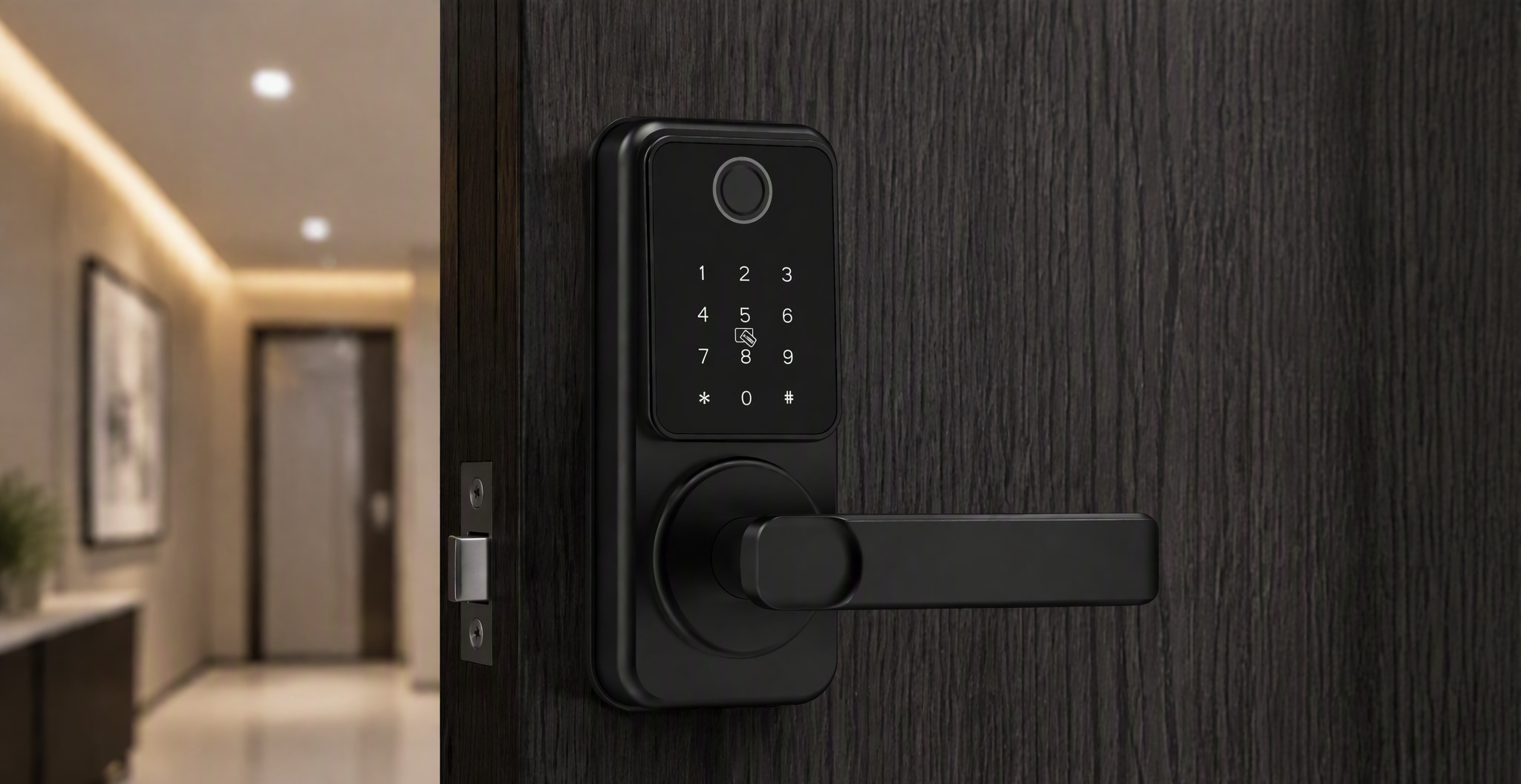
Beyond the tests, a few specification choices pay off specifically in hot-humid markets. Build in unlock redundancy: no biometric reads a dripping-wet finger consistently, so doors should offer fallback methods — the RF-2 pairs its semiconductor fingerprint sensor (identification in about 1.5 seconds, capacity 100) with IC card (capacity 50), anti-peep password, app access via built-in Tuya WiFi on 2.4GHz networks, and the mechanical key. Plan battery logistics as a scheduled cycle rather than a surprise per door, and make sure a flat battery is an inconvenience rather than a lockout — the RF-2's USB-C emergency power port lets staff open a door with any power bank. And verify certifications match the destination market: FCC-ID for the United States, CE-RED for the European Union, with documentation a customs broker or project consultant can actually check.
Why Service Economics Matter More in the Tropics
Here is the compounding problem: hot-humid markets raise failure rates, and at the same time many Southeast Asian markets have thin technician networks — a service call can mean days of waiting and cross-island travel, pushing the real cost of a single visit well beyond the $50–$150 industry range once logistics are counted. A conventional smart lock turns every climate-related failure into that visit, because the electronics are sealed into the lock and the whole unit must come off the door.
Trueway's patented key-swappable structure (US 12,499,723 B1 · DE202025001780 · CN201610502753, design patents CN202630085403 / CN202630085870) inverts the logistics. The climate-sensitive parts — reader, electronics, firmware — live in the front-panel module. Turn the mechanical key right to open the door; turn it left 90° and the module releases; a replacement module at $15–$45 clicks into place in under 10 seconds, installed by the distributor's own staff or even trained facility personnel. Spare modules ride normal parcel networks in padded envelopes, so a distributor in Manila can service a customer in Cebu the next day without a technician. The platform is designed to cut after-sales service visits by up to 80%, and spare inventory shrinks to Stock Modules, Not Locks — critical in markets where working capital and warehouse space are expensive.
Climate Risk → Specification Response
| Climate Risk | What It Attacks | Specification Response |
|---|---|---|
| Salt air (coastal cities) | Finishes, screws, exposed contacts | Salt-spray-tested hardware; swappable modules if corrosion wins |
| Condensation cycles | Electronics inside the assembly | Aging-tested modules; electronics replaceable at $15–$45 |
| Heat above 40°C | Battery life, adhesives, plastics | Scheduled battery cycles; USB-C emergency power |
| Wet fingers, monsoon rain | Biometric read reliability | Redundant unlock: fingerprint + IC card + password + app + key |
| Thin technician networks | After-sales cost and downtime | Module-level service: under-10-second key swap, no technician dispatch |
Run a Climate Pilot Before You Scale
The strongest de-risking step costs little: a pilot batch placed on the doors that represent your worst cases — a coastal hotel corridor, a non-air-conditioned apartment stairwell, a resort locker area — and run through a wet season. Track failure events, battery replacement intervals and support tickets, and compare them against the supplier's claims. Trueway supports small trial orders for exactly this purpose, and because the module defines the feature set, one pilot batch with a mixed module kit can cover hotel, apartment and office configurations at once. For OEM and ODM partners building their own brand for the region, the same pilot structure validates custom configurations under local climate stress before the volume order commits.
FAQ
Which climate tests should I demand from a smart lock supplier?
Three by name: salt-spray testing (corrosion resistance for coastal and humid markets), high/low-temperature cycling (electronics and battery behavior across extremes), and aging tests (early-life failure screening). Trueway runs all three at its Zhongshan factory before packaging — ask any supplier for the same list and for what the test duration and criteria are.
Does fingerprint recognition work reliably with wet or sweaty fingers?
Semiconductor sensors handle everyday moisture reasonably well, and the RF-2's semiconductor fingerprint sensor identifies in about 1.5 seconds — but no fingerprint technology reads a dripping-wet finger consistently. The practical spec for humid markets is redundancy: the RF-2 backs fingerprint with IC card (capacity 50), password, app and key, so a failed read is a retry with another method, not a lockout.
What happens when batteries degrade faster in the heat?
Plan a shorter, scheduled battery replacement cycle instead of reacting to failures door by door. If a battery does run flat, the RF-2's USB-C emergency power port lets staff open the door with any power bank — no locksmith visit. The key-swappable module design also means a heat-damaged electronic module is a $15–$45 spare part swapped with a key in under 10 seconds, not a lock replacement.
How do I run after-sales in markets where technicians are scarce?
Shift the repair unit from the lock to the module: replacements at $15–$45 ship in padded envelopes through normal parcel networks, and on-site staff install them with the mechanical key in under 10 seconds — replacing technician dispatches at $50–$150 that may take days to schedule across islands or provinces. The platform is designed to cut after-sales service visits by up to 80%.
Can I test the locks in my climate before a volume commitment?
Yes — and in a hot-humid market you should. Trueway supports small trial orders: place a pilot batch on representative doors (a coastal corridor, a non-air-conditioned stairwell, a pool-side locker area), run it through a monsoon season, and track failure events and battery consumption before scaling.
Learn more: RF-2 product page · production & QC · patents & certifications · B2B FAQ.
Related reading: The Speed Advantage: How After-Sales Response Time Becomes a Smart Lock Distributor's Competitive Edge · Hotel Door Lock Systems: How to Choose a Supplier for Bulk Projects.
Planning a project in a hot-humid market? Ask for a pilot batch quotation with a mixed module kit.正在高温高湿市场规划项目?欢迎索取含混合模块套件的试点批次报价。