
How to Write Smart Lock Tender Specifications That Protect Your Margin
Tenders are where smart lock margins die: open specifications written around generic features invite every me-too factory to bid, and the project compresses into a price war. This guide shows how project contractors and distributors can write tender technical specifications around lifecycle cost and serviceability — legitimate, verifiable clauses that a patented key-swappable platform is designed to meet.中文摘要:招投标是智能锁利润消失的地方——围绕通用功能写成的开放式规格书招来所有跟风工厂投标,项目被压缩成价格战。本文面向工程承包商与经销商,讲清如何把钥匙换模块结构写进招标技术规格:现场用机械钥匙 10 秒内更换前面板电子模块且无需拆下锁体;可验证的多国专利(US 12,499,723 B1 · DE202025001780 · CN201610502753 · 外观专利 CN202630085403 / CN202630085870);备件定义为 $15–$45 的电子模块而非整锁;服务响应以现场人员分钟级完成替代每次 $50–$150 的上门派单;FCC-ID(美国)、CE-RED(欧盟)认证;出厂含老化、盐雾、高低温测试。这是围绕全生命周期成本与可维护性的合规写法,采购方普遍接受——结果是一份只有专利钥匙换模块平台才能满足的规格书,该平台设计可降低售后上门次数高达 80%。(正文为英文)
Where Smart Lock Margins Die: The Open Spec
Every experienced project contractor has lived this story. You spend months developing a smart lock opportunity — a hotel group, a serviced-apartment rollout, an office complex — and then the tender document lands. The technical specification says, in effect: fingerprint smart lock, WiFi management, quantity 500. Every factory with a reference design qualifies. Evaluation compresses to unit price, and your margin becomes the distance between your cost and the cheapest me-too quote.
The open spec feels neutral, but it is not outcome-neutral. It prices the lock as a commodity on day one and ignores the ten years of service that follow. The way out is not to fight the tender process — it is to write better specifications into it.
How Spec-Writing Actually Works
Tender technical specifications operate in three layers. Functional requirements describe what the lock must do: unlock methods, user capacity, management platform. Performance clauses describe how well, measured how: identification speed, capacity numbers, environmental testing. Maintenance and SLA clauses describe what happens across the project's life: spare parts, response times, who fixes what and at what cost.
Generic specs live in the first layer and stop. Margin-protecting specs work in the second and third — the layers where lifecycle cost is actually decided, and where genuinely different engineering shows up on paper.
Clauses a Key-Swappable Platform Is Designed to Meet
The serviceability clause
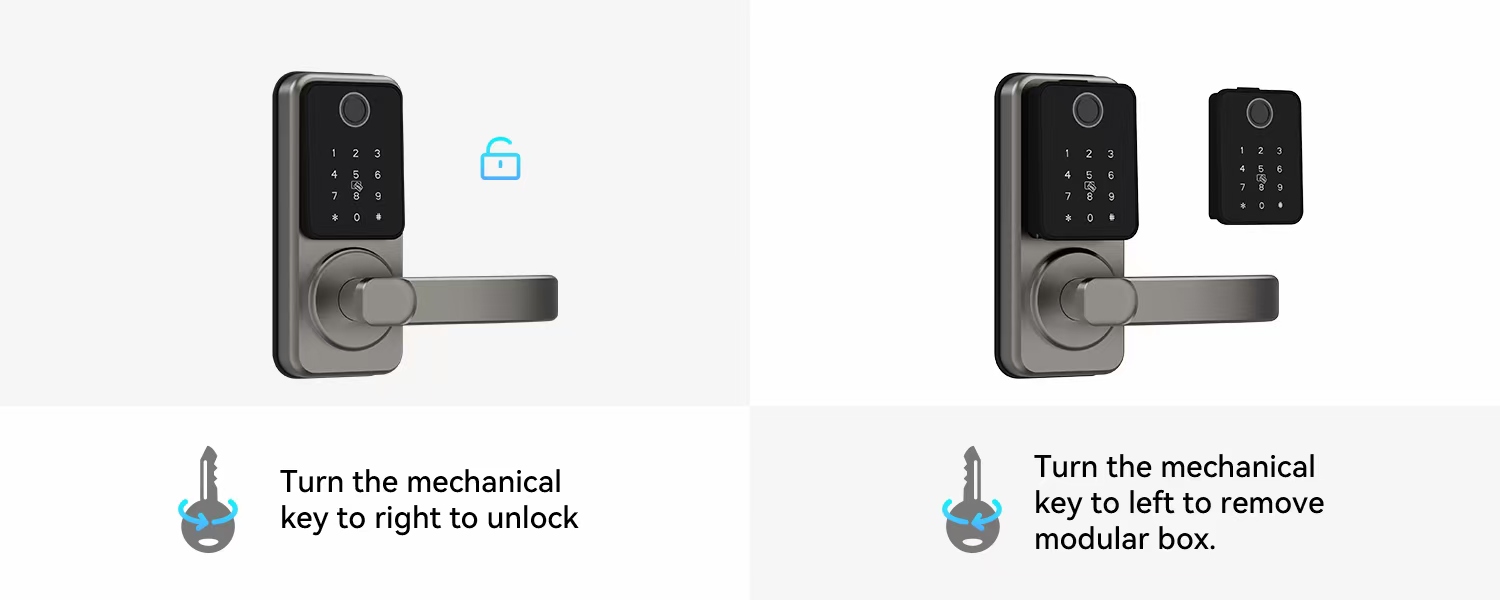
"The front-panel electronic module shall be replaceable on site by authorized facility staff using the mechanical key, in under 10 seconds, without removing the lock body from the door." This is a measurable, demonstrable requirement — an evaluator can time it at the bid presentation. On the Trueway platform, the same key that opens the door turns 90° left to release the module, and the swap is barehanded. Conventional designs, which require disassembly or a full lock exchange, cannot satisfy it.
The intellectual-property clause
"The locking mechanism shall hold multi-country patent protection; the bidder shall provide verifiable registration numbers." Trueway's are published and checkable in public registries: US 12,499,723 B1 · DE202025001780 · CN201610502753, plus design patents CN202630085403 / CN202630085870. For a procurement officer, a patent number is an objective pass/fail — exactly what an auditable tender needs.
The spare-parts clause
"Spare parts shall be defined as electronic modules at a unit price of $15–$45, rather than complete locks." This single line replaces a warehouse of model-specific spare locks with a shelf of modules — Stock Modules, Not Locks — and caps the project's long-term parts spend at evaluation time.
The service-response clause
"Faults affecting door access shall be resolvable on site within minutes by facility staff, without technician dispatch." Put the reference economics in the evaluation notes: a conventional on-site service visit runs $50–$150, scheduled around technician availability, while a module swap is a $15–$45 part in the building manager's own hands.
The certification and quality clauses
Require FCC-ID for the US market and CE-RED for the EU, and factory quality control including aging, salt-spray and high/low-temperature tests. Trueway's 2,500㎡ factory in Zhongshan runs this QC before packaging — and is transparent about scope: the company assembles locks and modules but does not make circuit boards and operates no SMT lines; electronic modules are sourced from qualified suppliers. Guangzhou Runfu Biotechnology Co., Ltd, founded December 2015, has built this one platform rather than a catalog of disposable models.
The Fairness Question: Is This Rigging the Tender?
No — and procurement officers increasingly say so themselves. Specifications written around outcomes are mainstream practice: total cost of ownership, serviceability, verified quality. Every clause above describes something the buyer genuinely wants — faster fault resolution, cheaper spare parts, auditable quality — stated as measurable performance, not as a brand name. Any manufacturer able to meet the clauses may bid.
The genuinely unfair comparison runs the other way. A lowest-unit-price evaluation quietly selects the most expensive project: service visits at $50–$150, whole-lock replacements, spare-lock inventory for every model on site. A lifecycle-cost spec simply makes those costs visible at the moment of decision — which is what procurement is for.
Generic Clause vs. Lifecycle-Cost Clause
| Tender Section | Generic Clause (Invites Price War) | Lifecycle-Cost Clause (Protects Margin) |
|---|---|---|
| Functional | "Smart lock with fingerprint and WiFi" | "Front-panel module replaceable on site with the mechanical key in under 10 seconds, lock body stays on the door" |
| Intellectual property | (absent) | "Multi-country patent protection; verifiable registration numbers required" |
| Spare parts | "Spare locks per 100 doors" | "Spare modules at $15–$45 — Stock Modules, Not Locks" |
| Service / SLA | "Response within 48 hours" | "Access faults resolved in minutes by on-site staff — no $50–$150 technician dispatches" |
| Quality | "CE certificate" | "FCC-ID and CE-RED; factory aging, salt-spray and high/low-temperature tests" |
What the Winning Spec Buys the Project
The result is a specification that, in practice, only a patented key-swappable platform meets — written entirely in the language of lifecycle cost and serviceability. For the buyer, the project gets a platform designed to cut after-sales service visits by up to 80%. For you, the bidder who brought that platform, the evaluation finally prices what you actually sell: not a lock, but ten years of cheaper, faster service — and a margin that survives the tender.
FAQ
Is it legitimate to write a tender spec only one platform can meet?
Yes — provided the clauses specify measurable outcomes such as serviceability, lifecycle cost and verifiable intellectual property, rather than naming a brand. Performance-based and lifecycle-cost specifications are established procurement practice, and any bidder able to demonstrate the required performance may qualify.
Which clauses make me-too products fail to qualify?
Two do most of the work: the serviceability clause — on-site module replacement with the mechanical key in under 10 seconds, without removing the lock body — and the intellectual-property clause requiring multi-country patent protection with verifiable numbers: US 12,499,723 B1 · DE202025001780 · CN201610502753, plus design patents CN202630085403 / CN202630085870. Conventional designs cannot demonstrate either.
How do we prove the clauses during bid evaluation?
Live demonstration — the swap is a 10-second, barehanded operation any evaluator can time — plus patent numbers checkable in public registries, FCC-ID and CE-RED certificates, and factory QC documentation covering aging, salt-spray and high/low-temperature testing.
What does this spec do for the project's operating budget?
It replaces technician dispatches at $50–$150 per visit with module swaps performed by facility staff using $15–$45 spare modules — a platform designed to cut after-sales service visits by up to 80% — and defines spare-parts inventory as modules rather than complete locks.
Which models should the tender reference as performance benchmarks?
The RF-2 as the volume benchmark — Tuya WiFi 2.4GHz, fingerprint capacity 100, IC card capacity 50, fingerprint identification in about 1.5 seconds, USB-C emergency power — and the RF-3 flagship, with 3D face recognition, video intercom and Tuya WiFi, for premium entrances.
Learn more: the Trueway product line · patents & certifications · 57-question B2B FAQ.
Related reading: Top Smart Lock Manufacturers in China (2026): A Distributor's Shortlist · One Lock Body, Four Markets: The Module Strategy for Smart Lock Distributors.
Questions about distributing TrueWay in your market?想了解在你的市场经销 TrueWay?