
How to Negotiate MOQ and Trial Orders with a Smart Lock Factory
The MOQ conversation is where most smart lock sourcing relationships either start well or go wrong. This playbook explains what actually drives minimum order quantities inside a Chinese lock factory, which terms are genuinely negotiable, how to structure a trial order that tests the supplier and not just the product — and how a modular, key-swappable platform cuts the cost of finding out.中文摘要:起订量谈判是智能锁采购合作走向正轨或误入歧途的第一个关口。本文拆解中国锁厂 MOQ 背后的真实成本动因,说明哪些条款真正有谈判空间、如何设计一个既测产品又测供应商的试单,以及模块化钥匙换模块平台如何降低试错成本。(正文为英文)
What Actually Drives MOQ Inside a Lock Factory
MOQ is not an arbitrary wall — it is the factory's way of pricing its own fixed costs into your order. Three things set the floor. First, material batching: lock bodies, panels and cylinders are purchased or machined in batches, and a small order leaves the factory holding unused stock. Second, line setup: every assembly run has changeover and first-article inspection costs that are the same whether the run is 50 units or 5,000. Third, customization: printed packaging, branded faceplates and localized manuals each carry their own minimums from upstream printers and tooling shops. Understanding which of the three is driving a quoted MOQ tells you where the negotiation room is — a factory can often flex on customization scope far more easily than on material batches.
What Is Genuinely Negotiable
Experienced buyers separate the conversation into hardware quantity and everything else. The hardware floor is the hardest to move, but the surrounding terms are not: you can often start with standard, unbranded hardware at a low quantity and add logo, packaging and manual customization once volume justifies the print runs. Payment terms for first orders, lead-time commitments, and bundled spare parts are all live topics. One useful test of a supplier's intentions: ask for a small bundle of spare modules with the trial order. A factory planning a long relationship treats spares as a service commitment; a factory planning a one-off transaction treats them as an annoyance.
Structuring a Trial Order That Actually Tests Something
A trial order has two jobs: validate the product and validate the supplier. Most buyers only do the first. A well-structured pilot looks like this: a handful of sample units first — bench test them, install them on real doors, run fingerprint enrollment, check the app flow on the RF-2's built-in Tuya WiFi (2.4GHz), test the USB-C emergency power port with a flat battery. Then a pilot batch of a few dozen units placed in a real environment — a rental building, a small hotel, an office floor — and run through one full usage cycle. Track three numbers: failure events, support tickets per unit, and time-to-resolution. Those three numbers predict your after-sales cost at volume better than any datasheet.
Crucially, the pilot should also stress the service chain: simulate a failure, request a replacement part, and measure how the supplier responds. This is where the lock's architecture decides the cost of the exercise. On a conventional smart lock, a "failed" unit means a technician visit at $50–$150 or a whole lock shipped back. On Trueway's patented key-swappable platform (US 12,499,723 B1 · DE202025001780 · CN201610502753, design patents CN202630085403 / CN202630085870), the front-panel module — reader, electronics, firmware — releases with a 90° left turn of the mechanical key, and a replacement module at $15–$45 clicks into place in under 10 seconds. Simulating and resolving a failure in the pilot costs a padded envelope, not a service call. The platform is designed to cut after-sales service visits by up to 80% — and the pilot is where you verify that claim with your own stopwatch.
How Modular Design Makes the Trial Itself Cheaper
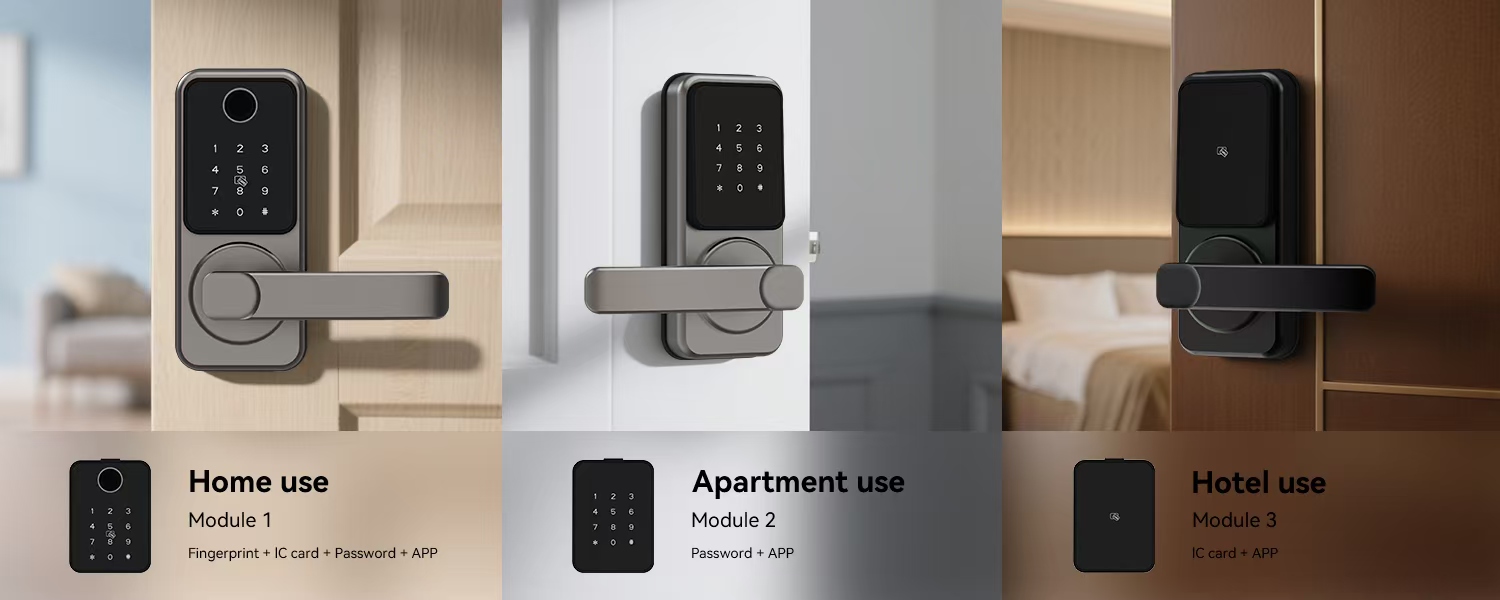
There is a second, less obvious way modularity lowers trial cost: one small order can test several market configurations at once. Because the module defines the feature set, a single batch of lock bodies plus a mixed module kit covers a fingerprint variant for apartments, a card-focused variant for hotels and a mixed variant for offices — without buying three separate product lines. Your trial order doubles as a market test across segments, and your spare-parts pool from day one is Stock Modules, Not Locks: a drawer of $15–$45 modules instead of a cage of model-specific spare locks tying up working capital.
Trial Order Levers: What to Put on the Table
| Negotiation Lever | Typical Factory Position | Buyer's Play |
|---|---|---|
| Hardware quantity | Hardest floor — driven by material batching | Accept standard finishes/configs to lower the floor |
| Logo & packaging customization | Separate minimums from printers | Defer branding to order two; start unbranded |
| Configuration mix within one order | Often rigid on conventional platforms | On a modular platform, mix modules freely on one lock body |
| Spare parts bundle | Frequently an afterthought | Insist on $15–$45 spare modules with the pilot — it tests the service chain |
| Payment & lead time | Standard terms quoted by default | Negotiate against a written volume roadmap |
Red Flags and Green Flags in the MOQ Conversation
Red flags: a factory that quotes one MOQ for everything regardless of configuration, refuses to itemize what drives the number, or cannot produce certification documents with verifiable references (FCC-ID for the US market, CE-RED for the EU). Green flags: a factory that explains its cost structure, offers a staged path (samples → pilot batch → volume), and is transparent about its own supply chain. Trueway's position is a useful benchmark: the company assembles locks and modules at its 2,500㎡ Zhongshan factory with aging, salt-spray and high/low-temperature testing before packaging, states plainly that it does not manufacture circuit boards and operates no SMT lines — electronic modules come from qualified suppliers — and supports small trial orders precisely because the module architecture makes them cheap to service. A supplier confident in its product economics has no reason to force a large first commitment.
FAQ
What is a realistic trial order size for smart locks?
Enough to test the product and the supplier without overcommitting: typically a handful of sample units for bench and door testing, then a pilot batch of a few dozen units installed on real doors for one usage cycle. Trueway supports small trial orders, and because modules are interchangeable, one small batch can test several market configurations at once.
Which terms are usually negotiable besides quantity?
Customization scope (logo, packaging, language strings) can often start small while hardware stays standard; payment terms, lead time and spare-module bundles are all levers. A factory that will not discuss any of these for a first order is signaling how it will behave later.
How does the key-swappable module design reduce trial cost?
One lock body plus a set of interchangeable modules lets you test fingerprint, card and mixed configurations on the same hardware — the module defines the feature set, so a single small order covers multiple market variants. Spare modules at $15–$45 also make the pilot's after-sales simulation cheap: simulate a failure, swap the module with a key in under 10 seconds, and measure the process.
What should I verify during a factory audit or video call?
Ask for the QC steps by name — aging tests, salt-spray testing, high/low-temperature cycling — and for certification documents (FCC-ID for the US, CE-RED for the EU) with verifiable numbers. Ask whether the factory makes its own circuit boards: Trueway states plainly that it assembles locks and modules but operates no SMT lines, sourcing electronic modules from qualified suppliers — that kind of transparency is what you want from any supplier.
When should I move from trial to volume?
When three things are proven: the product survived one real usage cycle with acceptable failure rates, the after-sales process works (module swap speed, spare supply), and the commercial terms at volume — price breaks, lead time, territory policy — are in writing. A pilot that only tests the product but not the service chain tells you half the story.
Learn more: full product line · production & QC · patents & certifications · B2B FAQ.
Related reading: Smart Lock Manufacturer in China: An OEM/ODM Buyer's Guide for Distributors · How to Choose a Smart Lock Supplier for Your Market: 7 Checks for Distributors.
Want to structure a trial order — lock bodies plus a mixed module kit — for your market?想为你的市场设计一套试单方案(锁体 + 混合模块套件)?