
The 10-Second Sales Demo: Turning the Key-Swap Into Your Strongest Closing Tool
Every smart lock datasheet looks the same across a trade-show booth or a showroom shelf. What stops a distributor mid-stride is watching a lock being serviced with nothing but its own key: turn 90° left, module out, module in, door back in service in under 10 seconds. This is the demo playbook — setup, script, objection handling, and how to convert that moment into trial orders.中文摘要:在展会或展厅里,智能锁的参数表看起来都一样。真正能让经销商停下脚步的,是亲眼看到仅用一把钥匙就能维修一把锁:左转 90°,模块弹出,新模块推入,10 秒内恢复使用。本文是演示手册——布置、话术、异议处理,以及如何把这个瞬间转化为试单。(正文为英文)
Why Datasheets Don't Close Smart Lock Deals
Walk any security trade fair and count the smart lock booths. Every wall shows the same feature grid: fingerprint, card, password, app. A distributor who visits ten suppliers collects ten nearly identical brochures, and the decision compresses into price and payment terms. That dynamic serves the cheapest factory — and punishes everyone whose advantage is engineering rather than cost.
The way out is to sell something a datasheet cannot show. For Trueway partners, that something is the key-swappable structure: a patented mechanism (US 12,499,723 B1 · DE202025001780 · CN201610502753, design patents CN202630085403 / CN202630085870) that lets the mechanical key release the entire front-panel module. Demonstrated live, it reframes the conversation from "what does the lock cost" to "what does owning five hundred of these cost."
The Demo Setup: What You Need on the Table
The bar is deliberately low, because the demo works in a booth, a showroom, a hotel corridor or a customer's office:
- One lock body mounted on a demo door or display board — the RF-2 is the volume workhorse; add the RF-3 flagship if the buyer runs premium projects.
- Two or three spare front-panel modules, ideally different configurations (for example the fingerprint module and the hotel card-only module).
- The mechanical key — the same key that opens the door.
- A stopwatch, or the buyer's own phone timer. Letting the buyer time you is part of the effect.
No tools, no power supply, no screwdriver, no technician's bag. The absence of equipment is itself a message: this is what a "service call" looks like on this platform.
The 60-Second Script
The demo lands hardest when the buyer holds the key. Hand it over and narrate:
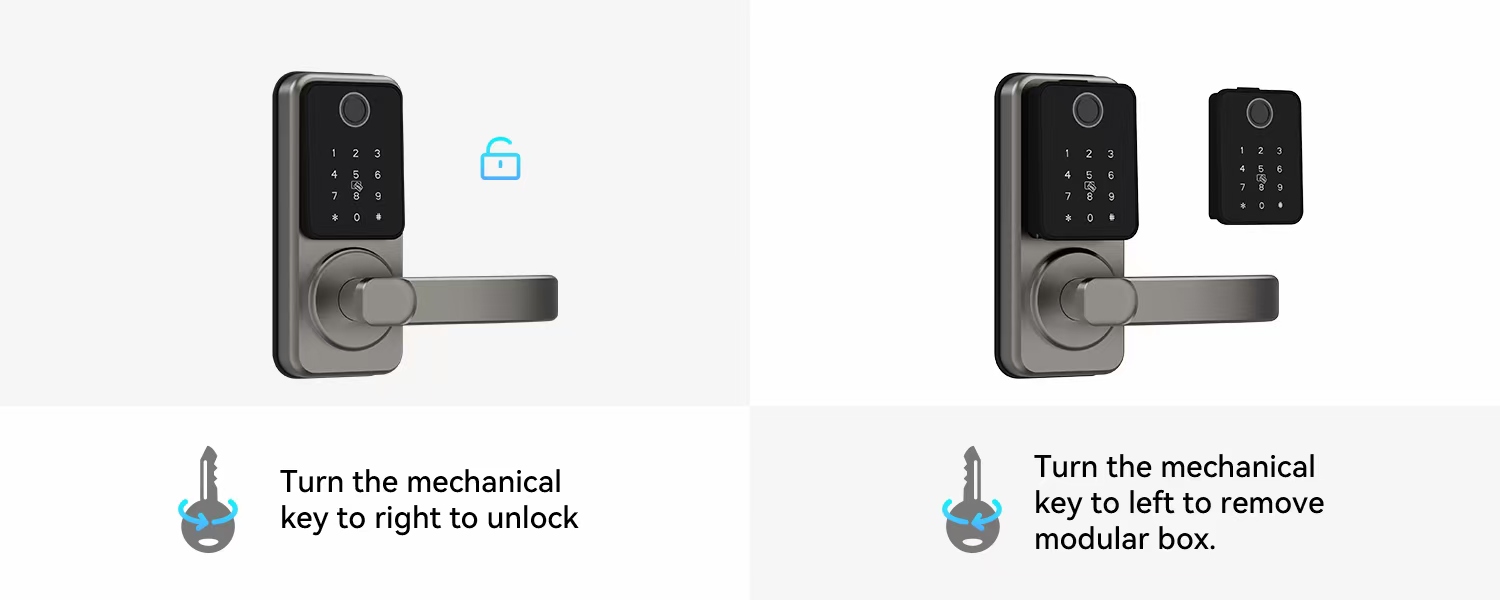
- "Turn right to open." The door unlocks — normal key behavior, nothing to learn.
- "Now imagine the fingerprint reader has failed." With a conventional lock, this is where the buyer's brain starts pricing a technician visit.
- "Turn the same key 90° left." The front-panel module releases. No disassembly, no wiring harness, no lock body coming off the door.
- "Slide it out. Slide the spare in." The module clicks into place.
- "Turn right. Open." The lock is back in service — typically in under 10 seconds, timed by the buyer.
Turn Right to Open. Turn Left to Swap. By the second run-through, most buyers stop watching the lock and start asking about module pricing — which is exactly where you want the conversation.
What Each Moment of the Demo Proves
The demo is not theater; every step answers a line item on the buyer's P&L. The module release answers after-sales cost: a conventional failure means a technician dispatch at $50–$150 per visit, while a replacement module costs $15–$45 and goes in with a key. The swap speed answers downtime: a hotel room or rental unit with a failed lock is out of order inventory, and minutes matter. The spare modules on the table answer warehousing: Stock Modules, Not Locks — a shelf of modules replaces a cage of model-specific spare locks. And the fact that the buyer performed the swap answers labor: facility staff, not locksmiths, close the ticket. Together, that is why the platform is designed to cut after-sales service visits by up to 80%.
Demo Moment → Buyer Takeaway
| Demo Moment | What the Buyer Sees | The Margin Story It Tells |
|---|---|---|
| Key turns 90° left, module releases | Service without disassembly | $15–$45 module replaces a $50–$150 technician visit |
| Swap timed on the buyer's phone | Under 10 seconds, barehanded | Door back in service in minutes — no out-of-order rooms or units |
| Different module slides into the same body | One lock, multiple feature sets | One SKU covers home, rental, hotel and office doors — leaner warehouse |
| Spare modules lined up on the table | Small, light, cheap to stock | Stock Modules, Not Locks — after-sales inventory that fits in a drawer |
| Patent numbers on the spec card | US 12,499,723 B1 · DE202025001780 · CN201610502753 | A feature competitors cannot copy — pricing power that survives negotiation |
Handling the Three Standard Objections
"Does the mechanism wear out if swapped often?"
The structure is engineered for repeated swaps and validated before packaging at Trueway's 2,500㎡ Zhongshan factory with aging, salt-spray and high/low-temperature testing. The key path is a conventional brass cylinder interface designed for daily use. One transparency point buyers respect: Trueway assembles locks and modules but does not make circuit boards and operates no SMT lines — electronic modules come from qualified suppliers, and the company says so plainly.
"Isn't the key-swap a security hole?"
Releasing the module requires the mechanical key turned 90° left — the same credential that opens the door. Anyone holding that key already has full access, so the swap path adds no new attack surface. The RF-2's electronic layers stay intact as well: semiconductor fingerprint identification in about 1.5 seconds, anti-peep passwords, and IC card capacity for 50 users.
"What does the ongoing supply look like?"
Modules are standard stock items at $15–$45, shipped in padded envelopes — no pallet logistics. Trueway supports small trial orders, so a distributor can validate the demo-to-order conversion with a single carton of locks plus a module kit before committing to volume. FCC-ID and CE-RED certifications cover the US and EU respectively.
From Demo to Purchase Order
The demo's job is to move the buyer from feature comparison to ownership economics. Close with the numbers the demo just proved: service visits at $50–$150 replaced by module swaps with $15–$45 parts; spare inventory defined as modules; and a patented structure the buyer's competitors cannot source from the same reference-design factories. Then make the next step small: a trial order, a demo kit with two or three modules, and a date for the buyer's own sales team to learn the 60-second script. The demo scales — every salesperson who can perform it carries the same closing tool into every customer meeting.
FAQ
What do I need to run the 10-second key-swap demo?
One Trueway lock body mounted on a demo door or display board, two or three spare front-panel modules, and the mechanical key. No tools, no power supply and no technician are required — the swap is a barehanded operation performed with the same key that opens the door.
Does frequent module swapping wear out the lock?
The structure is engineered for repeated swaps and validated at the factory in Zhongshan with aging, salt-spray and high/low-temperature testing before packaging. The module seats with a positive click, and the mechanical key path is a conventional brass cylinder interface designed for daily use.
Is the key-swap mechanism a security risk?
Module release requires the mechanical key turned 90° left — the same credential required to open the door. Anyone holding that key already has full access, so the swap path adds no new attack surface. The structure itself holds multi-country patent protection: US 12,499,723 B1 · DE202025001780 · CN201610502753, plus design patents CN202630085403 / CN202630085870.
How does the demo convert into distributor economics?
The demo makes the cost math tangible: a service visit typically costs $50–$150, while a replacement module costs $15–$45 and installs in under 10 seconds by facility staff. The platform is designed to cut after-sales service visits by up to 80%, and spare inventory shrinks to modules — Stock Modules, Not Locks.
Which models should be on the demo table?
The RF-2 as the volume model — Tuya WiFi 2.4GHz, fingerprint capacity 100, IC card capacity 50, fingerprint identification in about 1.5 seconds, USB-C emergency power — plus the RF-3 flagship with 3D face recognition and video intercom for premium projects. Both share the same key-swappable structure.
Learn more: RF-2 product page · full product line · patents & certifications · B2B FAQ.
Related reading: Revenue After the Sale: Turning Your Installed Base Into a Recurring Module Business · RF-2 Deep Dive: How a Key-Swappable Smart Lock Cuts After-Sales Costs by up to 80%.
Want a demo kit — lock body plus spare modules — to run the 10-second demo in your own showroom?想要一套演示套件(锁体 + 备用模块),在你自己的展厅里做 10 秒换模块演示?