
Office and Co-Working Smart Lock Procurement: A Project Buyer's Guide
Office and co-working projects look simple on a floor plan — a door count, a lock spec, a line in the budget — and get complicated the day people start joining, leaving, booking meeting rooms and losing cards. This guide walks through what project buyers and contractors should actually spec, and why the maintenance model behind the lock matters as much as the feature list on the quote.中文摘要:办公室与联合办公项目在图纸上看起来很简单——门的数量、锁的规格、预算里的一行——但从员工入职离职、会议室借用、门卡丢失的那天起就开始复杂。本文面向工程采购商与承包商,讲清该写什么规格(RF-2:Tuya WiFi 2.4GHz、指纹容量 100、IC 卡容量 50、识别约 1.5 秒、USB-C 应急供电、访客临时密码)、整层一种锁体按区域配置不同模块、故障时 10 秒钥匙换 $15–$45 模块对比 $50–$150 上门服务,以及采购核查表与旗舰 RF-3 入口方案。(正文为英文)
The Access Pain Points Offices Actually Pay For
Employee turnover is the first: every departure with an unreturned key or card is a security decision — rekey the door or accept the risk. Rekeying a conventional lock means a locksmith visit and a new set of keys; multiplied across a floor and a year of churn, it becomes a real line item.
Meeting rooms and focus rooms need access that opens and closes on a schedule without issuing physical credentials to every visitor. Server rooms and storage need restriction to a short list of people. After-hours cleaning crews need entry that works at night and expires before morning. And lost cards plus forgotten passwords land in the property manager's inbox every week. None of these are exotic; all of them cost money when the lock cannot flex.
What to Spec: The RF-2 Baseline for Office Doors
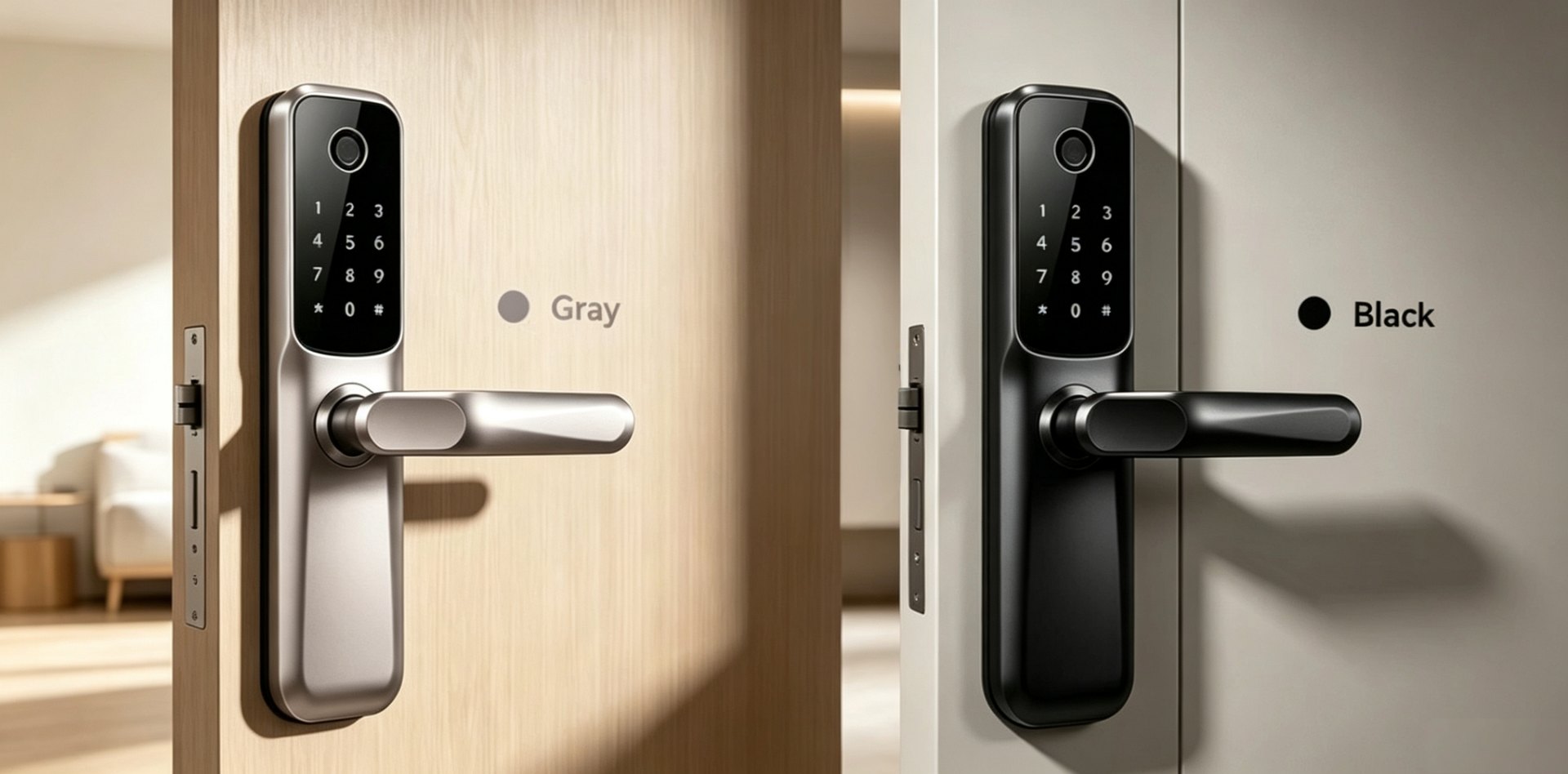
The Trueway RF-2 covers the standard office door spec: Tuya WiFi 2.4GHz app management for remote unlock and user administration, IC card capacity 50 and fingerprint capacity 100 per lock — enough for a departmental door or a busy meeting suite — with fingerprint identification in about 1.5 seconds, so queues do not form at 9 a.m.
For visitors, contractors and cleaning crews, administrators issue temporary passwords with defined validity windows instead of physical keys — access that expires on its own, with nothing to collect back. USB-C emergency power covers the flat-battery edge case: any common power bank wakes the lock for entry, without a locksmith call.
One Lock Body Across the Whole Floor
Office floors are not uniform: the main entrance, team rooms, meeting rooms, server room and executive offices want different credential mixes. Conventional procurement answers this with different lock models — different SKUs, different spare parts, different training. The key-swappable platform answers it with one lock body and different front-panel modules per zone: fingerprint + password + RFID where convenience matters, leaner configurations where it does not.
For the buyer this simplifies everything downstream: one installation standard for the contractor, one management app for the operator, one spare-parts list for maintenance. And when a room changes role — storage becomes a meeting room, a tenant takes another suite — the door is reconfigured with a module swap rather than a lock replacement.
The Maintenance Reality: Service Call vs. 10-Second Module Swap
Here is the number that decides office lock economics. When a conventional smart lock faults — reader dead, keypad unresponsive, firmware stuck — the fix is a technician visit at $50–$150, scheduled around business hours, while the room sits unusable or unsecured. On the Trueway platform, the same mechanical key that opens the door turns 90° left to release the front-panel module; on-site staff swap in a $15–$45 spare module in under 10 seconds, barehanded, and the faulty module goes back by courier. The platform is designed to cut after-sales service visits by up to 80%.
For co-working operators, where access problems are member-experience problems, the difference shows up in reviews and renewals. For contractors, it shows up in the maintenance clause you can offer — and in how few callback visits eat your project margin after handover.
Procurement Checklist for Office and Co-Working Locks
| Conventional Office Lock | Trueway Key-Swappable Spec | |
|---|---|---|
| Unlock methods | Keys or cards only | Fingerprint, IC card, password, app, mechanical key |
| Capacity per door | Varies by model | Fingerprint capacity 100, IC card capacity 50 (RF-2) |
| Visitor and cleaner access | Physical keys, shared cards | Temporary passwords with validity windows |
| Remote management | On-site programming | Tuya WiFi 2.4GHz app management |
| Failure response | Technician visit $50–$150, room out of use | Staff swap a $15–$45 module in under 10 seconds |
| Spare parts | Whole spare locks per model | Stock Modules, Not Locks — a drawer of module SKUs |
| Reconfiguration | Replace the lock | Swap the module; the lock body stays |
Premium Entrances: Where the RF-3 Fits
For the main entrance or a flagship co-working floor, the Trueway RF-3 is the flagship pull-handle option: 3D face recognition for hands-free entry, video intercom to screen visitors, and the same Tuya WiFi management. It sits on the same key-swappable platform — US 12,499,723 B1 · DE202025001780 · CN201610502753, with design patents CN202630085403 / CN202630085870 and multi-country patent protection — so the maintenance model stays identical across the building: any fault, any floor, one module swap.
A pragmatic spec many project buyers land on: RF-2 across the interior doors, RF-3 at the entrances, one module shelf behind both.
FAQ
How do offices handle employee turnover without rekeying doors?
Delete the departed employee's fingerprint, card and password in the Tuya app — credentials are per-user, so offboarding is an app action, not a locksmith visit. With no keys in circulation, leavers take nothing physical with them that could be copied or kept.
Can visitors and cleaning crews get time-limited access?
Yes. Administrators issue temporary passwords with defined validity windows for visitors, contractors and after-hours cleaning crews. The credential expires on schedule; there is no card to recover and no rekeying after the job ends.
What happens when an office smart lock fails?
On the key-swappable platform, on-site staff turn the mechanical key 90° left, release the front-panel module and swap in a spare in under 10 seconds — no technician visit, no room out of service. A replacement module costs $15–$45, versus $50–$150 for a conventional on-site service call.
How many users can one RF-2 door support?
Fingerprint capacity 100 and IC card capacity 50 per lock, with passwords and app users managed in Tuya — comfortably covering departmental doors and meeting suites. Fingerprint identification takes about 1.5 seconds, so morning peak traffic keeps moving.
Which Trueway model should we spec for the main entrance?
The RF-3 flagship pull-handle model: 3D face recognition, video intercom and Tuya WiFi, on the same key-swappable platform as the RF-2 — so one maintenance model and one module stock cover the whole project.
Learn more: the Trueway product line · patents & certifications · 57-question B2B FAQ.
Related reading: Smart Locks for Rental Apartments and Airbnb: A Procurement Guide · Fingerprint vs. Face Recognition Smart Locks: A Project Procurement Guide.
Questions about distributing TrueWay in your market?想了解在你的市场经销 TrueWay?