
Revenue After the Sale: Turning Your Installed Base Into a Recurring Module Business
Most smart lock businesses end at the invoice: the lock ships, the margin is booked, and the customer relationship goes quiet until something breaks. Modular architecture changes that arithmetic. Every lock you install becomes a node in a parts-and-upgrades network that keeps generating orders — spares, upgrades, reconfigurations — for the life of the door. This article maps the three recurring revenue streams and the numbers behind them.中文摘要:大多数智能锁生意在开发票那一刻就结束了:锁发出、利润入账、客户关系沉寂,直到出问题。模块化架构改变了这笔账。你装出的每一把锁都成为一个零件与升级网络的节点,在门的整个生命周期里持续产生订单——备件、升级、重配置。本文拆解三条复购收入流及其背后的数字。(正文为英文)
The Problem With One-Time Lock Sales
The conventional smart lock P&L has a single line: units × margin. After that, every customer interaction is a cost center. A failed fingerprint reader means a technician dispatch at $50–$150 per visit, or a full replacement lock under warranty. A customer who outgrows the feature set buys a competitor's next model. The installed base — often thousands of doors for an established distributor — sits there generating nothing but liability.
Distributors feel this as a growth ceiling: revenue resets to zero every January. Brand owners feel it as churn: the customer relationship is owned by whoever answers the next service call. The structural reason is the same in both cases — on a conventional lock, the electronics are fused to the lock body, so nothing after the sale can be a sale.
The Installed Base Is an Asset — If the Lock Is Modular
Trueway's key-swappable platform separates the durable part of the lock from the part that evolves. The lock body, mortise and cylinder stay on the door for years; the front-panel module — electronics, reader, keypad — releases with the mechanical key turned 90° left and swaps in under 10 seconds, barehanded. The Lock Stays. Only the Module Travels.
That single design decision converts the installed base from a warranty liability into a customer list. Every door running your locks is a door that will, over its life, need parts, want features, and change hands or use. Each of those events is a module order, and modules are a product with healthy margins, parcel-post logistics and no installation labor attached. The structure is protected by multi-country patents — US 12,499,723 B1 · DE202025001780 · CN201610502753, plus design patents CN202630085403 / CN202630085870 — so this aftermarket cannot be undercut by generic reference-design factories.
Stream 1: Spare Modules — After-Sales as Profit, Not Cost
On a conventional platform, after-sales is a line you minimize. On a modular platform, it is a line you grow. A failure that used to cost a $50–$150 technician visit is now a $15–$45 module sold to the customer and installed by their own facility staff with a key. The platform is designed to cut after-sales service visits by up to 80% — and the visits that remain become parts shipments.
The inventory economics are equally favorable. Stock Modules, Not Locks: a drawer of modules at $15–$45 each covers a service territory that used to require a cage of model-specific spare locks at full unit cost. Working capital tied up in service stock drops by an order of magnitude, and every module on the shelf is a future sale rather than a sunk warranty provision.
Stream 2: Upgrade Modules — Selling New Features to Doors You Already Own
Electronics improve faster than doors wear out. On a conventional lock, the customer who wants a better fingerprint reader or a new connectivity option replaces the whole lock — and the replacement sale goes to whichever brand is cheapest that quarter. On the modular platform, the upgrade is a module swap into the lock body already on the door.
For the distributor, this turns the installed base into an upgrade market: a property group that standardized on the RF-2 — Tuya WiFi 2.4GHz, fingerprint capacity 100, IC card capacity 50, identification in about 1.5 seconds, USB-C emergency power — is a standing audience for every higher-tier module released later. The customer keeps their installation investment; you keep the account. The upgrade conversation happens on your terms, because the swap path only exists on your platform.
Stream 3: Reconfiguration Swaps — When the Property Changes, the Module Changes
Buildings change use more often than locks fail. An apartment unit becomes a short-stay rental; a serviced apartment converts to a hotel license; an office floor becomes a coworking space. Each conversion traditionally means ripping out and replacing door hardware — a project cost that customers delay and distributors never see.
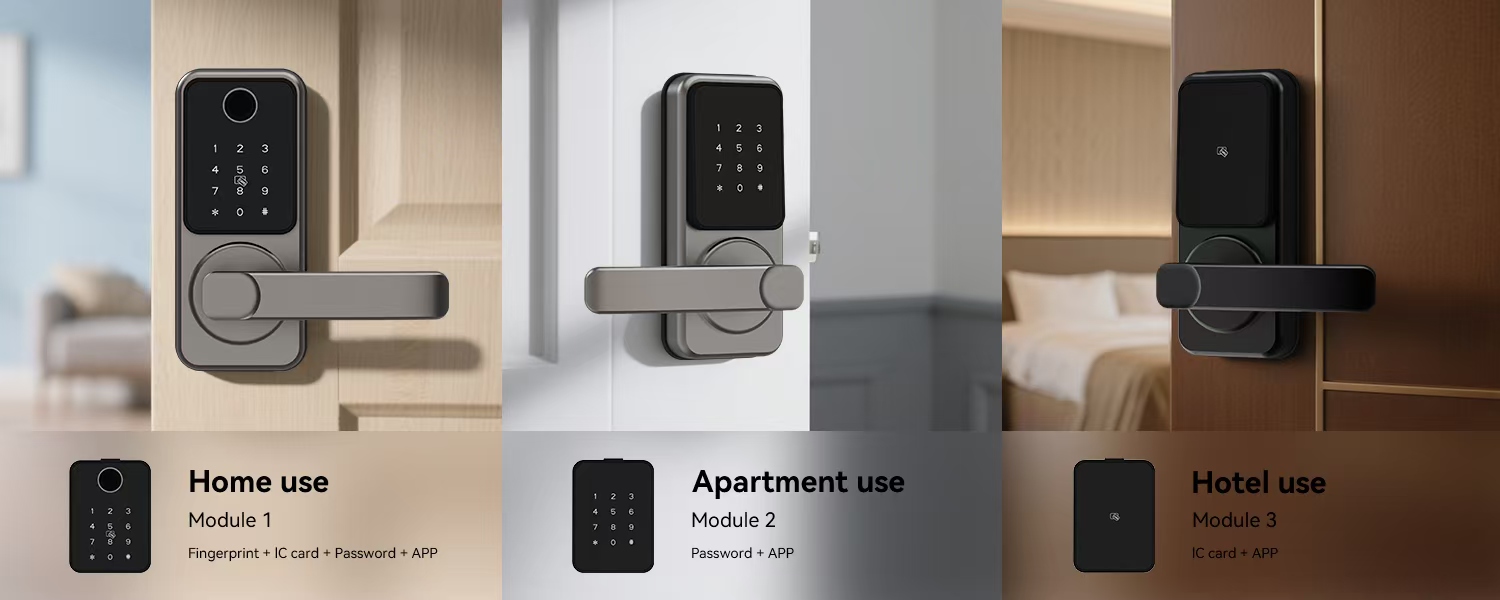
With swappable modules, reconfiguration is an afternoon: fingerprint module out, hotel card module in, no locksmith, no new drilling, no disposal. For OEM and ODM partners this is also a product-strategy lever — one lock body serves home, rental, hotel and office segments, so the same installed base can be re-sold into whichever segment the property market moves toward.
Revenue Stream → What It Replaces
| Recurring Stream | Trigger Event | Conventional Platform | Modular Platform |
|---|---|---|---|
| Spare modules | Component failure | $50–$150 technician visit or full-lock warranty replacement | $15–$45 module sale, customer self-installs in under 10 seconds |
| Upgrade modules | Customer wants new features | Whole-lock replacement — sale often lost to a competitor | Module sale into your existing installed base |
| Reconfiguration swaps | Property changes use or tenant profile | Hardware rip-out and replacement project | Module swap with the mechanical key — no locksmith, no drilling |
| Service inventory | Ongoing after-sales coverage | Cage of model-specific spare locks | Stock Modules, Not Locks — a drawer of $15–$45 modules |
What This Means for Your Business Model
The shift is from hunting new accounts to farming the ones you have. A distributor with 5,000 installed modular locks owns a parts-and-upgrades market that renews itself with every failure, every feature cycle and every property conversion — revenue that compounds instead of resetting. Because the swap is a 10-second key operation, none of it requires a technician network: the service channel is a parcel carrier.
Supply-side, the model is easy to run. Trueway's 2,500㎡ Zhongshan factory validates every module with aging, salt-spray and high/low-temperature testing before packaging, and FCC-ID and CE-RED certifications cover the US and EU. In the interest of transparency: Trueway assembles locks and modules but does not manufacture circuit boards and operates no SMT lines — electronic modules come from qualified suppliers, which keeps module supply scalable. Small trial orders are supported, so a distributor can seed a market with a carton of locks plus a module kit and let the installed base build the recurring stream.
FAQ
What are the three recurring revenue streams on a modular lock platform?
Spare modules for after-sales service ($15–$45 per unit replacing $50–$150 technician visits), upgrade modules that add features to already-installed locks, and reconfiguration swaps when a property changes use — for example a rental unit converting from fingerprint to hotel card mode. All three ship as small parcels, not pallets.
Why can't a conventional smart lock generate the same after-sale revenue?
On a conventional design the electronics are fused to the lock body, so any failure or feature change means replacing the entire lock — a warranty cost, not a sale. On Trueway's key-swappable platform, the electronics are a field-replaceable module that releases with the mechanical key turned 90° left, so every service event and every upgrade becomes a parts transaction.
How much inventory does a module-based spare program require?
Stock Modules, Not Locks. Modules are small, light and model-agnostic across the RF series — a drawer of modules covers what used to require a cage of model-specific spare locks. Modules cost $15–$45 each, so a meaningful service stock fits a working-capital budget that a spare-lock program cannot approach.
What protects this revenue model from copycat suppliers?
The key-swappable structure holds multi-country patent protection — US 12,499,723 B1 · DE202025001780 · CN201610502753, plus design patents CN202630085403 / CN202630085870. Generic reference-design factories cannot offer the same mechanism, so the module aftermarket stays attached to the platform.
How do upgrade modules work in practice?
The lock body, cylinder and installation stay on the door; only the front-panel module changes. A buyer who installed the base RF-2 configuration — Tuya WiFi 2.4GHz, fingerprint capacity 100, IC card capacity 50 — can later receive a higher-tier module and perform the swap in under 10 seconds with the mechanical key, no technician and no reinstallation.
Learn more: RF-2 product page · full product line · patents & certifications · B2B FAQ.
Related reading: Stock Modules, Not Locks: Smarter Spare Parts Inventory for Smart Lock Distributors · The 10-Second Sales Demo: Turning the Key-Swap Into Your Strongest Closing Tool.
Want the module pricing sheet and a trial kit to start building your installed-base revenue stream?想要模块价格表和试单套件,开始搭建你的装机基础复购收入?