
Fingerprint vs. Face Recognition Smart Locks: A Project Procurement Guide
Fingerprint or face recognition? On a single door it is a preference; on a 300-door project it is a cost structure. This guide compares the two biometrics on hardware cost, enrollment friction, field failure modes and after-sales exposure — and shows how a key-swappable modular platform lets you spec both without doubling your risk.中文摘要:指纹还是人脸?单门是偏好问题,300 门的项目则是成本结构问题。本文从硬件成本、录入摩擦、现场故障模式和售后敞口四个维度对比两种生物识别方案,并说明钥匙换模块平台如何让你同时配置两种方案而不加倍风险。(正文为英文)
Two Biometrics, One Procurement Decision
Every smart lock datasheet now lists both fingerprint and face recognition, so the tender question arrives sooner or later: which one do we spec? Answered from a feature list, the question is unanswerable — both unlock doors. Answered from a project P&L, the two biometrics differ in four places that matter to a distributor or project buyer: the hardware cost per door, the labor of enrolling users at handover, the ways each technology fails in the field, and what each failure costs to fix. Multiply those differences by 300 doors and a five-year service window, and the biometric line item stops being a preference and becomes a cost structure.
The Case for Fingerprint: The Volume Workhorse
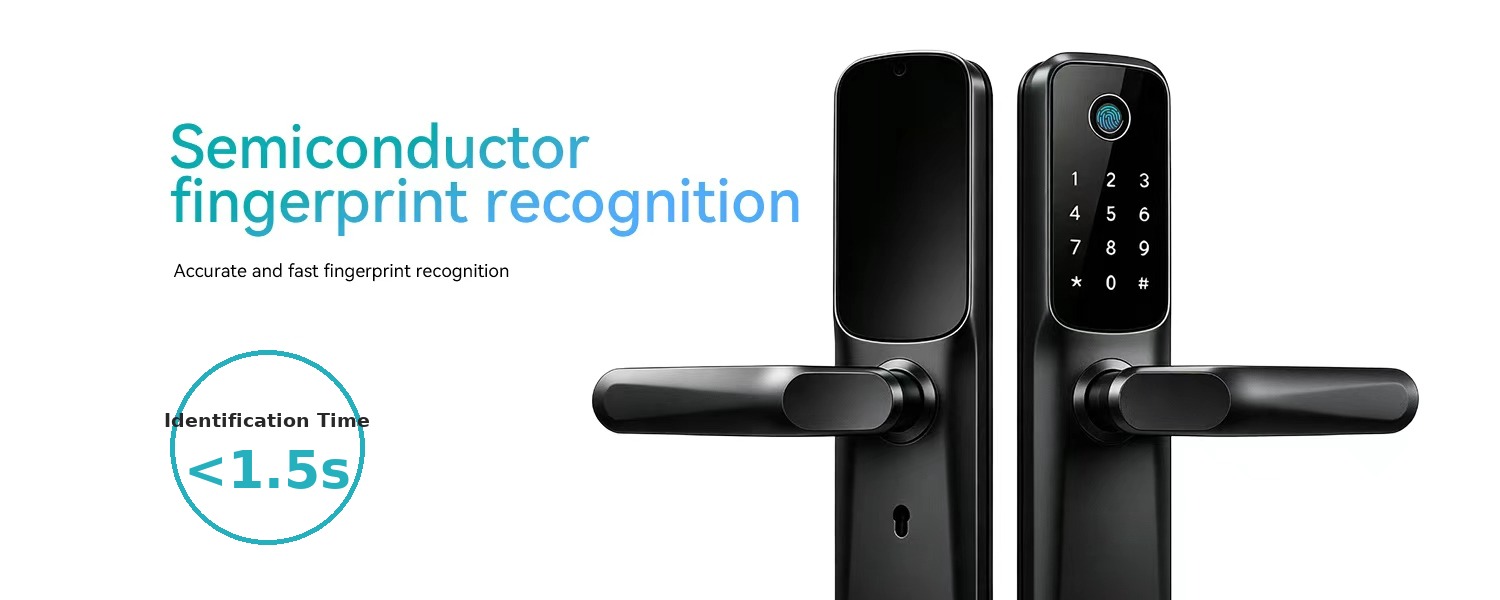
Fingerprint remains the default for volume doors for sound commercial reasons. The sensors are mature and inexpensive, enrollment takes seconds per user at move-in, and the failure modes are well understood by any facility team. The Trueway RF-2 is built around this reality: a semiconductor fingerprint sensor with identification in about 1.5 seconds and capacity for 100 fingerprints, backed by IC card (capacity 50), anti-peep password, app control and the mechanical key. Built-in Tuya WiFi on 2.4GHz networks handles remote unlock, temporary passwords and unlock-record review as standard, and a USB-C port provides emergency power if batteries run flat.
For apartments, student housing, office doors and mid-market hotels, this configuration covers the access policy without paying a premium per door. It is also the configuration with the deepest installed base, which means the largest pool of reference projects when your own customers ask for proof.
The Case for Face Recognition: Where the Premium Pays Back
Face recognition earns its higher per-door cost in specific zones, not across the whole building. Premium residential entrances and penthouses, hotel VIP floors, and executive office suites are the classic fit: the hands-free experience is part of what the occupant is paying for. There are also functional cases — elderly residents whose fingerprints have worn smooth, facilities where hygiene policies discourage touch, and doors where users routinely arrive with hands full.
The Trueway RF-3 flagship serves this tier: a pull-push design with 3D face recognition, video intercom and Tuya WiFi. The procurement discipline is to deploy it surgically — the entrance doors and premium floors where the experience justifies the price — rather than blanket-specifying it across doors where fingerprint would do the same job for less.
The Real Risk: Being Unable to Change Your Mind
On a conventional smart lock, the biometric is fused into a sealed unit. If the spec turns out wrong — tenants reject the readers, a face module struggles with a backlit lobby, a fingerprint batch underperforms — the correction means removing locks, scheduling technicians and paying for re-installation, at $50–$150 per service visit before hardware. The spec decision is effectively irreversible once the project is installed, which is why buyers over-deliberate it.
Trueway's patented key-swappable structure (US 12,499,723 B1 · DE202025001780 · CN201610502753, design patents CN202630085403 / CN202630085870) removes that irreversibility. The biometric lives in the front-panel module, not the lock body. Turn the mechanical key right to open the door; turn it left 90° and the module releases. A different module — different biometric, different feature set — slides in and clicks into place in under 10 seconds, with the lock body staying on the door. A replacement module costs $15–$45 instead of a technician visit at $50–$150, and the platform is designed to cut after-sales service visits by up to 80%. The spec becomes a reversible, module-level decision — and your spare-parts pool becomes Stock Modules, Not Locks.
Fingerprint vs. Face Recognition: The Procurement View
| Procurement Factor | Fingerprint (RF-2) | Face Recognition (RF-3) |
|---|---|---|
| Hardware cost per door | Lower — mature sensor supply chain | Higher — reserve for premium zones |
| Enrollment at handover | Seconds per user; capacity 100 fingerprints | Fast per user; best for low-traffic premium doors |
| Field failure modes | Worn or wet fingers, sensor wear | Challenging lighting, mounting-height constraints |
| Typical doors | Apartments, offices, mid-market hotels, rentals | Luxury residences, VIP floors, executive suites |
| Connectivity & backup | Tuya WiFi 2.4GHz; USB-C emergency power | Tuya WiFi; video intercom built in |
| After-sales unit | Same on both: a $15–$45 swappable module, installed with a key in under 10 seconds | |
How to Spec a Mixed Project
The strongest project specs zone the building instead of picking one biometric for everything. Volume doors — apartments, offices, standard hotel rooms — go fingerprint on the RF-2. Entrance doors and premium floors go face recognition on the RF-3. Because both models share the same key-swappable structure, the installer learns one lock body, the facility team keeps one spare-module pool, and the after-sales math is identical across zones. If a zone's choice proves wrong after handover, the correction is a module swap, not a refit.
One transparency point worth putting in your own tender documents: Trueway assembles locks and modules at its 2,500㎡ Zhongshan factory with aging, salt-spray and high/low-temperature testing, but does not manufacture circuit boards and operates no SMT lines — electronic modules come from qualified suppliers. FCC-ID and CE-RED certifications cover the US and EU respectively. For OEM and ODM partners, module configurations can be customized to the project mix, with small trial orders to validate the zoning before volume.
FAQ
Which biometric should I standardize on for an apartment or hotel project?
For volume doors, fingerprint is the practical default: lower hardware cost, fast enrollment and mature field behavior — the RF-2 pairs a semiconductor sensor (identification in about 1.5 seconds, capacity 100) with IC card, password, app and key. Reserve face recognition for premium entrances and VIP floors, where the RF-3's 3D face recognition and video intercom justify the higher per-door cost.
Does face recognition work in dim corridors or backlit entrances?
The RF-3 uses 3D face recognition, which is designed to handle low-light corridors better than 2D camera-based systems. Lighting, mounting height and sun exposure still vary by building, so we recommend validating with a sample unit installed at the actual door before committing to volume — Trueway supports small trial orders for exactly this purpose.
What does the biometric choice do to my after-sales budget?
On a conventional lock, a failed reader of either type means a technician visit at $50–$150 and a lock off the door. On Trueway's key-swappable platform, the reader is part of the front-panel module: a replacement module costs $15–$45 and installs in under 10 seconds with the mechanical key. The platform is designed to cut after-sales service visits by up to 80%.
Can I mix fingerprint and face recognition doors under one OEM program?
Yes. Because the module defines the biometric, one lock body covers both: fingerprint modules for standard doors, face recognition configurations for premium doors, all under one SKU family, one installer skill set and one spare-parts pool. Trueway's OEM/ODM program supports custom module configurations with small trial orders before volume commitments.
How do I validate the choice before a bulk order?
Run a two-step pilot: install fingerprint units on representative volume doors and a face recognition unit on the premium entrance, then measure enrollment time, false-rejection complaints and support tickets over one tenant turnover cycle. Modules can be reconfigured after the pilot with a key turn, so the pilot does not lock in the final specification.
Learn more: RF-2 product page · RF-3 product page · patents & certifications · B2B FAQ.
Related reading: RF-2 Deep Dive: How a Key-Swappable Smart Lock Cuts After-Sales Costs by up to 80% · One Lock Body, Four Markets: The Module Strategy for Smart Lock Distributors.
Planning a project that mixes fingerprint and face recognition doors? Ask for a module-level quotation.正在规划指纹与人脸混合配置的项目?欢迎索取按模块拆分报价。