
WiFi vs. Bluetooth Smart Locks for Rental Projects: What the Connectivity Choice Really Costs
The WiFi vs. Bluetooth question looks like a spec-sheet detail until you run a rental portfolio: every tenant turnover, cleaner visit and lost credential becomes either a remote click or a site visit. This article runs the per-100-unit math on gateways, pairing labor, credential turnaround and battery logistics — and covers the service layer that matters whichever radio you choose.中文摘要:WiFi 还是蓝牙?在参数表上是细节,在租赁组合运营里却是成本分水岭:每次换租、保洁上门、钥匙丢失,要么是远程一键,要么是派人跑现场。本文按每 100 台测算网关、配对人工、凭证下发时效与电池后勤,并说明无论选哪种连接都绕不开的售后维修层。(正文为英文)
Connectivity Is Not a Feature Line — It Is an Operating Cost
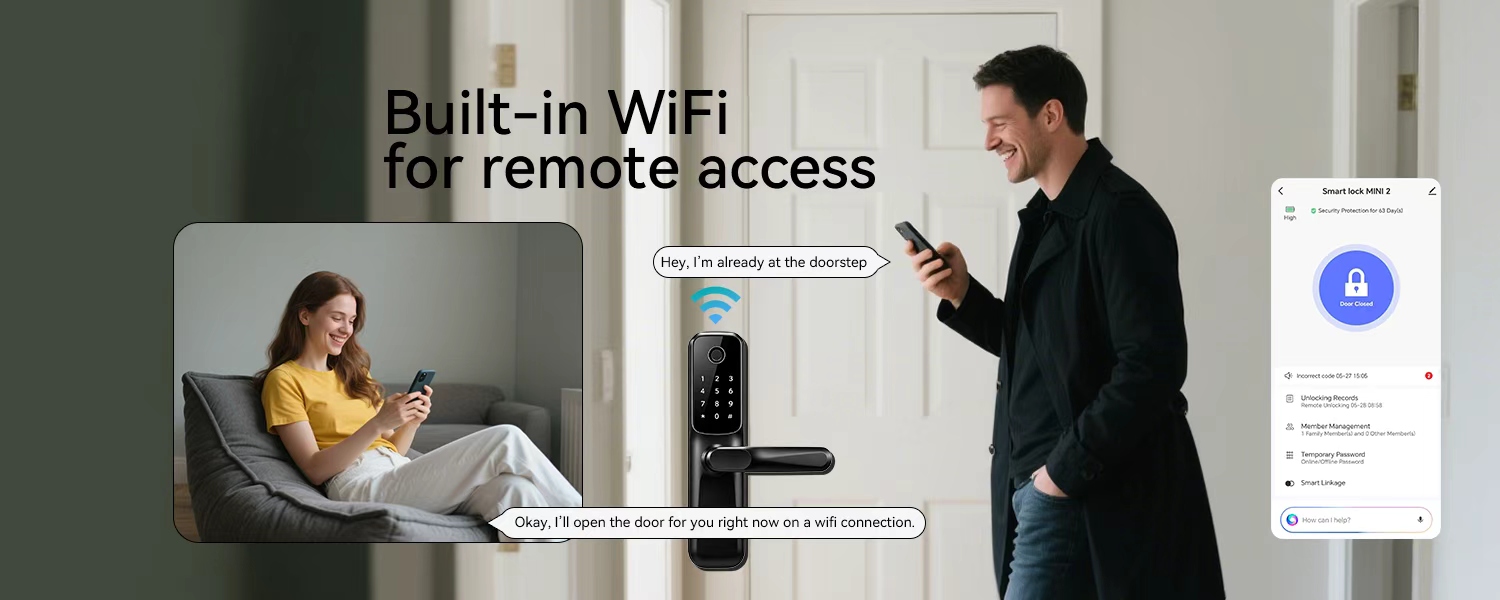
A rental portfolio generates access events constantly: tenant turnover, cleaning crews, maintenance contractors, short-stay guests, lost phones and cards. Each event needs a credential issued, changed or revoked. The connectivity choice decides what each of those events costs. With direct-to-cloud WiFi, the event is a click in an app. With Bluetooth-only locks, the event is either within Bluetooth range of the door — meaning someone physically goes there — or it depends on extra gateway hardware between the lock and the internet. Multiplied across a hundred units and a year of turnovers, that difference dwarfs the price gap on the lock itself.
Bluetooth Locks: Lower Sticker Price, Hidden Field Labor
Bluetooth locks win the first line of the quotation: the radio is cheap and sips power, so the lock hardware costs less and batteries last longer. The costs arrive later, in operations. Remote credential management requires a gateway per unit or per floor — hardware to buy, install, power and pair. Pairing is field labor: someone stands at each door with a phone. When a gateway drops offline, remote features silently stop until a site visit restores them. And because the lock only talks to the cloud when a phone or gateway is in range, unlock records and battery status can lag reality by days. None of this is disqualifying — for a small portfolio in a single building where staff are on-site anyway, Bluetooth is a rational choice. The mistake is pricing it as if the gateways, pairing visits and blind spots were free.
WiFi Locks: Direct to Cloud, Built for Portfolios
A WiFi lock carries its own connection, so every remote function works without intermediate hardware. The Trueway RF-2 ships with built-in WiFi for 2.4GHz networks through the Tuya Smart app as standard, not an option: managers issue temporary passwords to guests and cleaners from a phone, unlock remotely for a contractor, and review unlock records per door — across as many units as the portfolio holds. Tenant turnover stops being a rekeying event; the old credentials are deleted and new ones issued in minutes, from anywhere.
The trade-offs are real but manageable. WiFi radios draw more power than Bluetooth, so battery replacement cycles belong in the operating budget as a scheduled task per building rather than a surprise per door. And if a unit's battery does run flat, the RF-2's USB-C emergency power port lets staff open the door with any power bank. The 2.4GHz band — sometimes quoted as a limitation — is in practice the right choice for locks: it penetrates walls better than 5GHz and works with virtually every router a tenant will ever install.
The Per-100-Unit Math
Run both options as an operations budget, not a hardware quote. On the Bluetooth side: one gateway per unit or floor, pairing labor per door at installation, a site visit whenever a gateway fails, and slower credential turnaround at every turnover. On the WiFi side: a modest premium per lock, no gateway hardware, no pairing visits, and a scheduled battery cycle. For distributed portfolios — apartments across multiple buildings, Airbnb units across a city — the WiFi configuration typically recovers its premium within the first year of avoided site visits. For a single building with permanent on-site staff, Bluetooth can still pencil out. The table below structures the comparison.
| Cost Driver (per 100 units) | Bluetooth-Only Locks | WiFi Locks (RF-2) |
|---|---|---|
| Gateway hardware | One per unit or floor — purchase, power, replacement | None — the lock connects directly |
| Installation labor | Door install + gateway pairing visit per door | Door install + app onboarding on 2.4GHz |
| Credential turnaround at turnover | Minutes if gateway online; a site visit if not | Minutes, fully remote, via Tuya Smart app |
| Unlock records & status | Delayed until a phone or gateway syncs | Near real-time per door |
| Battery logistics | Longer intervals between replacements | Scheduled cycle per building; USB-C emergency power as backup |
| Best fit | Single building, on-site staff, small portfolios | Distributed rentals, serviced apartments, Airbnb portfolios |
The Layer That Matters Either Way: Serviceability
Whichever radio you choose, locks still live a physical life: readers fail, batteries die early in a hot stairwell, keypads wear. On a conventional lock, each of those events is a technician dispatch at $50–$150 per visit, with the unit out of service until the visit happens. Trueway's patented key-swappable structure (US 12,499,723 B1 · DE202025001780 · CN201610502753, design patents CN202630085403 / CN202630085870) changes the unit of repair from the lock to the module. Turn the mechanical key right to open the door; turn it left 90° and the front-panel module — reader, electronics, firmware — releases. A replacement module at $15–$45 slides in and clicks into place in under 10 seconds, installed by your own staff, no tools. The platform is designed to cut after-sales service visits by up to 80%, and spare inventory simplifies to Stock Modules, Not Locks: a drawer of modules instead of a cage of model-specific spare locks.
One transparency point for your supplier file: Trueway assembles locks and modules at its 2,500㎡ Zhongshan factory with aging, salt-spray and high/low-temperature testing before packaging, but does not manufacture circuit boards and operates no SMT lines — electronic modules come from qualified suppliers, and the company says so plainly. FCC-ID and CE-RED certifications cover the US and EU respectively. Distributors and OEM/ODM partners can trial the platform with small orders — one building, one module kit — before scaling across a portfolio.
FAQ
Does the RF-2 still work when the WiFi goes down?
Yes. Local credentials — fingerprint, IC card, password and the mechanical key — keep working because they are verified on the lock itself. Only remote functions pause until the router is back. A USB-C port provides emergency power if batteries run flat during an outage.
Is 2.4GHz WiFi a limitation for rental projects?
It is the right band for locks: 2.4GHz travels farther through walls than 5GHz and is available on virtually every router a tenant will install. The RF-2 connects to 2.4GHz networks through the Tuya Smart app, which keeps onboarding simple for property staff.
How do I handle battery logistics across a WiFi-connected portfolio?
Plan a scheduled replacement cycle per building rather than reacting to low-battery alerts one door at a time. If a battery does run flat before the cycle, the USB-C emergency power port lets staff power the lock from any power bank and open the door — no locksmith, no out-of-service unit.
Can I pilot the platform before committing a whole portfolio?
Yes. Trueway supports small trial orders so you can equip one building or a handful of units, run them through a real turnover cycle, and measure credential turnaround, battery consumption and support tickets before scaling. OEM and ODM partners can also trial custom configurations under their own brand.
How does after-sales work across a distributed rental portfolio?
The key-swappable structure turns most electronic failures into a mail-order event: a replacement module at $15–$45 ships in a padded envelope, and on-site staff install it with the mechanical key in under 10 seconds — replacing a technician visit at $50–$150. The platform is designed to cut after-sales service visits by up to 80%.
Learn more: RF-2 product page · full product line · patents & certifications · B2B FAQ.
Related reading: Smart Locks for Rental Apartments and Airbnb: A Procurement Guide · Stock Modules, Not Locks: Smarter Spare Parts Inventory for Smart Lock Distributors.
Running the numbers on a rental portfolio? Get a per-unit connectivity and spares quotation for your market.正在为租赁项目做测算?欢迎索取按台计的连接与备件方案报价。